Question and Answer

Question and Answer
by Theodora Goss

When I’m not at all sure why I’m doing what I do,
I ask my Lady, and she says, because I told you to.

Just as I tell the crocuses to push up out of the ground,
or the tulips to open their petals, or the sun
to come out from behind a cloud and shine on the water
so light dances on the waves — look, can you see them?

Just as I tell the oak trees to grow, or the snow
to melt, or the birds to return after winter.
Like them, you sing the song that you’ve been given.

You’re doing what I told you: let that be enough,
let that be your answer. Now go dance on the water,
perch in a tree or push up out of the ground,
open your petals to the sun. Go sing your song.

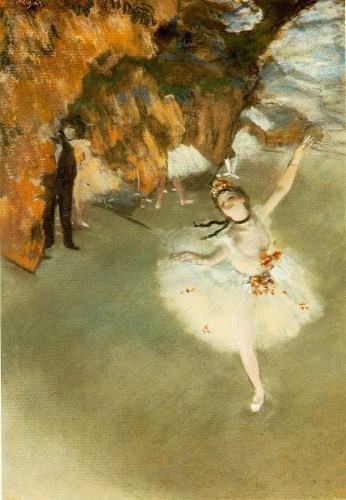
A Birthday by Emma Florence Harrison

(The illustration is A Birthday by Emma Florence Harrison.)

Posted in Uncategorized | 2 Comments

The Snowdrops

The Snowdrops
by Theodora Goss

I’m bringing you a message:

That the snowdrops are worth listening to,
and if you listen carefully, you can hear them,
but you must get down on your knees, head low
to the ground, as though praying.

They say that spring is more important
than whatever else you were doing, which you thought
was so important.

They say: Look, we’re growing all around you
out of last year’s leaf litter, as you should be growing,
silently, almost imperceptibly, from what you were
into a newer version of yourself.

They say: It’s time. If you weren’t sure whether
it was time, well then it is.

They say: Be joyful, as we are. And you can see
that they are, in their fresh radiance.

They are making you a promise. Although
it may snow again (after all, it’s only February),
although right now the wind is turning your cheeks
red and chapping your hands, although there is nothing
else poking out of the ground except the hellebores,
which are the flowers of winter,

spring is coming. If you pay attention, you can feel it
in the ground, and in yourself. Paying attention
to its arrival is a kind of prayer.

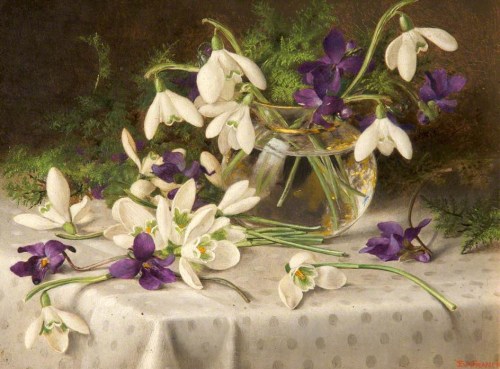
Snowdrops and Violets by Eva Francis

(The painting is Snowdrops and Violets by Eva Francis.)

Posted in Uncategorized | 4 Comments

An Education

An Education
by Theodora Goss

I was sent to school with witches,
and I learned the spells they speak
in a sharp gray mouse’s squeak
while making nine black stitches.

For their spells require small things:
the voice of the mouse, and a line
of hyphens in black twine
(oh, the might in colored strings),

drops that the lilies weep
when we shake them after dawn,
bits of cambric, bits of lawn,
and a doll’s eyes closed in sleep.

And it does not matter now
that our spells do petty things,
that they prick like hornets’ stings,
that they cannot scare a crow,

for the principle’s the same:
when we exorcise your moles
with our pretty rigmaroles
(which you think a charming game),

we remember other times,
when we rode the wings of the moon
and the stars rehearsed a tune
with consequential rhymes.

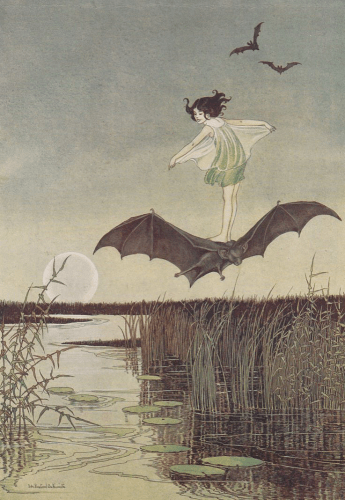
Illustration by Ida Rentoul Outhwaite

(Illustration by Ida Rentoul Outhwaite. This poem was published in my collection Songs for Ophelia.)

Posted in Uncategorized | Leave a comment

The Red Lilies

The Red Lilies
by Theodora Goss

This morning, the lilies are on fire,
metaphorically.

I don’t know where such passion comes from,
unless maybe they’re in love with the light
falling on them through the window:
a cold winter light, gray and blue,
in which the lilies are blazing.

Eventually, they’ll burn themselves out.
But meanwhile, I’m warming my hands by them,
which is a bit dangerous. If I get too close
and singe my fingers, and later people ask
what happened, I’ll have to explain
it was an accident, that I caught fire from the lilies
on my dining room table.

Every week, I buy myself flowers
at the market for three dollars a bunch:
Peruvian lilies, which are practical, they last so long,
especially if you remember to change the water.
But I never considered they could ignite,
even if only metaphorically.

Although people have died of metaphor.

Poetry is no safer than these lilies,
arranged in a green and gray pottery jar
on a lace doily crocheted by my grandmother.
Get too close, you will inevitably
start to burn.

Vase with Red Gladioli by Vincent Van Gogh

(The image is Vase with Red Gladioli by Vincent Van Gogh, which is the closest I could come to red lilies . . .)

Posted in Uncategorized | 2 Comments

Valentine’s Day

Valentine’s Day
by Theodora Goss

This is the coldest day of the year so far —
the kind of cold that hurts you to the bone,
that says to impatient bulbs, stay underground:
the world is dead, there’s nothing for you here.

And yet this is the day we’ve chosen to be
our Valentine, instead of some day in June
when birdsong would wake us, not this bitter cold —
when roses would actually be blooming. Crazy, isn’t it?

The thing is, we like to believe in what we can’t see,
we crazy humans. That bulbs will be daffodils
and crocuses, that those sticks poking out of the ground,
half-covered in burlap, are actually rose bushes,

that the warblers and wrens who are having a grand old time
in Mexico will decide to return again.
We believe in spring, we believe in promises,
we talk about love, that insubstantial notion,

convinced that it will sprout from the cold ground.
We are, all of us, incurable romantics.
And yet, before the snow fell, I could see,
poking out of the ground, a few green shoots.

I know they’re there, just waiting for a finger
of warmth to touch them. And when that delicate girl,
the spring, with sunlit hair, returns again
from wherever she’s been vacationing, they’ll grow,

filling our world with colors and fragrances.
We’ll forget our frostbitten cheeks, the icy sidewalks.
For now? We wrap ourselves in scarves and curse
the wind, and slip on ice, and talk about love,

convinced that it exists although we can’t see it —
hopeful or delusional, which may be
much the same thing. Meanwhile the world around us
lies (at least we hope) not dead but sleeping . . .

Illustration by Walter Crane

(The illustration is by Walter Crane.)

Posted in Uncategorized | Leave a comment

Chrysanthemums

Chrysanthemums
by Theodora Goss

These are the ragged flowers
present at every gravesite.

Imagine a cloud of petals
like a ruffled cockatoo,
like a slice of wedding cake
with the narrow end eaten,
a pile of lace with leaves
as tough as a toad’s skin,
smelling of aniseed.
We give these to the dead.

As they go into the darkness,
the heads of chrysanthemums
must light their way, like lamps.

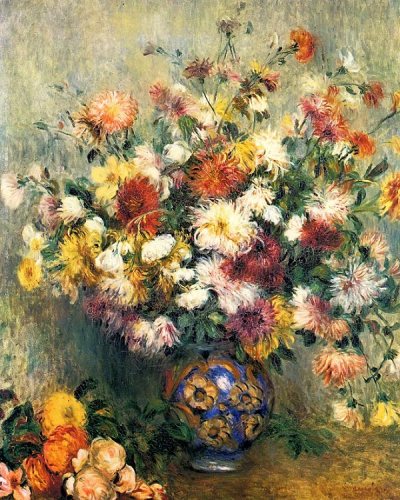
Bouquet of Chrysanthemums by Pierre-Auguste Renoir

(The painting is Bouquet of Chrysanthemums by Pierre-Auguste Renoir.)

Posted in Uncategorized | Leave a comment

Water Lilies, 1907

Water Lilies, 1907
by Theodora Goss

When he painted them,
was he tired? Did he have to brush away
a hovering dragonfly?

You can tell he loved the water,
because the painting is not of lilies
but of water in which lilies
happen to be floating. That is why
the lilies are just smears of pink and white
on the green leaves. And he loved not the leaves
themselves but their shadows. It is the water
on which he spent all his time:
how many different tubes of paint
it took, how much mixing, to represent
the way trees are reflected in it,
or the sky, or clouds in the sky.
The water, purple and green and blue,
is more beautiful than the flowers.
And most beautiful of all
is the light falling on the water,
the leaves, the flowers —
the light that was his great subject,
its presence always implied.

Did his back hurt? After a while
did he realize he was hungry,
that it was time for lunch?

What we are left with is a fragment
of the experience, framed:
shadows on the water,
a memory of light.
As though we were the dragonfly,
hovering, temporary.
Or perhaps the lilies, beautiful
and indistinct, perched
on what is real.

Water Lilies by Claude Monet

(The painting is, of course, Water Lilies by Claude Monet. It’s the painting that inspired this poem . . .)

Posted in Uncategorized | Leave a comment