The Apple Orchard

The Apple Orchard
by Theodora Goss

I have lived every day in this world
not knowing
who I was, distinct
from any other person
or where I was going,
except maybe to the grocery store.
Not knowing whether I had a purpose
other than to breathe the air
and provide a home for millions of bacteria.
Whether life had a meaning
other than simply getting through it.

What I have learned
is that one can move with a kind of grace,
rather like a poem
about the moon and apple blossoms,
slipping through the moments
easily, without anguish.
That a mask can become your true face,
like an opera singer who is a courtesan
one night, a peasant girl the next.
I have learned that art
is a compensation for death,
and to be an artificer, creating meaning
by pretending it exists.

I have claimed my place
in this indifferent world by dancing
to an aria of my own composing
through an apple orchard
that exists only in my head.
But you can see it, can’t you? When I describe
the branches swaying in the wind,
the apple blossoms white
in the moonlight, like moths
that have settled for a moment,
luminous and as evanescent
as this poem.

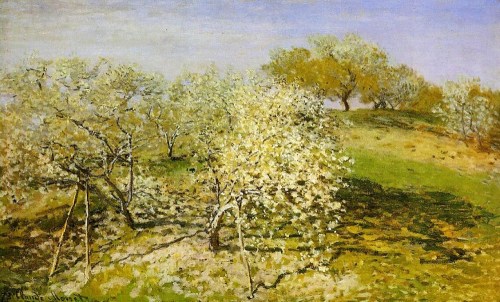
Apple Trees in Bloom by Claude Monet

(The painting is Apple Trees in Bloom by Claude Monet.)

Posted in Uncategorized | 6 Comments

The Ghost

The Ghost
by Theodora Goss

At night, when the others are all
asleep in their beds,
dreaming the incoherent
dreams of the night,
I sit in this room, alone
by the light of the lamp,
and I write.

Are my dreams as incoherent
as theirs, though I sit
awake? Sometimes I think so,
and feel so alone.
There is nothing like the night
to do that — the night
and the moon.

And then sometimes it winks
through the window, I think,
and suddenly I feel
comforted and at ease,
as though the chairs were my friends,
and the windows, and even
the trees.

And I think — philosophical, since
it is night, and the others
are all where they ought to be,
asleep in their beds —
that being a writer is rather
like being a ghost,
which needs

only the night and the lonely
light of the lamp,
and the friendly chairs — in short,
to haunt a room
where incomprehensible dreams
can cohere and
take form.

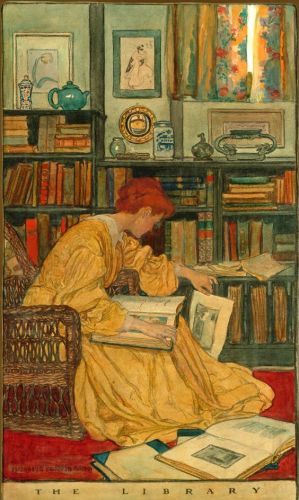
The Library by Elizabeth Shippen Green

(The image is The Library by Elizabeth Shippen Green.)

Posted in Uncategorized | Leave a comment

Goldilocks and the Bear

Goldilocks and the Bear
by Theodora Goss

They met when they were children.

She was a thief,
yellow-haired, small for her age,
only twelve years old, already hardened
by poverty, already a noted pickpocket,
stealing into the bears’ house.

He was a rube, a rustic,
or so she said then. A mark
is what she called him —
to his face, no less.

He was the one who found her in his bedroom,
trying to climb out the window,
and hid her in his closet
while his father raged:
who had stolen the carved wooden box
filled with gold coins, the profits
of their honey business?

He would not let her keep the coins.
He was not that much of a rube.

But while his father was talking to the constable,
a comical fellow straight out of Shakespeare,
he returned the box, saying he had found it
by the kitchen door, where the thief must have dropped it
on his way out. They should look in the forest —
he could be a mile away by now.

That night, he told her the coast was clear
and let her out the window.
At the last moment, before she made her escape,
she kissed him on the cheek
and laughed. That’s the way she was
back then, fearless.

He got on with his life,
finishing school, then going into the business,
learning how to care for the bees,
how to keep them healthy,
taking extension classes on bee diseases:
mites and spores that endanger bees directly,
hive beetles that infect their homes,
wax moths that feed on honeycombs,
damaging the larvae.
He learned what to plant in the fields,
how to prune the trees in the orchard:
to produce lavender honey, and clover,
and linden-flower.

He learned how to mold the wax sculptures
sold in the gift shop.
His mother was particularly good at those.

Meanwhile, she worked with a gang
of child thieves out of a Dickens novel:
ragged clothes, solidarity pacts,
the possibility of incarceration.
She ended up in jail once, was broken out,
continued to steal until she was fifteen
and their leader suggested prostitution.
It was, he said, an honorable profession,
as old as thieving. And she such a pretty girl,
with that yellow hair: she was sure to do well.
He would, of course, take a small percentage.
The suggestion was punctuated
by his fist on the table, and a grin
she did not like the look of.

That night she climbed up to the bear’s window —
she had not forgotten the location —
and knocked on the pane.
“Help me,” she said when he opened it.
“I need help, and you’re the only one
who’s helped me before.”

He listened patiently, then angrily:
three years’ worth of exploits
and exploitation. She showed him her wrist
where the gang leader had once broken it.
She was still small and pale from malnutrition.

They dyed her hair brown with walnuts.
He got her a job in the honey business,
first in the gift shop, then because she showed interest,
taking care of the bees.

She had never seen anything so fascinating:
like a city of soft, furry bodies
moving in a mass, then in individual flight,
seemingly wild, erratic, but purposeful.
She loved to watch them among the lavender,
the dusting of yellow pollen on their fur.
There was something purely joyful about them,
and they were always making, making —
thieves, like her, taking the nectar,
but making wax catacombs, the golden honey
more precious, she thought, than coins.

He showed her how to work among the bees,
wearing thick cotton and a hat veiled with musin,
which he did not need, protected by his pelt.
Eventually, he asked her to dinner
with his parents.

His mother said she was charming.
His father had a serious talk
with him: you can’t trust humans, he said.
They’re not like bears. Think of that thief, long ago,
who tried to take our gold.
They don’t even sleep in winter,
which is unnatural, unbearlike.
If you have to fall for someone, can’t it be
another bear from a good family,
like ours?

The bear explained that love
doesn’t work like that.

When he asked her to marry him
beneath the linden branches,
she said, aren’t you afraid
I might still be that girl?
That I might become a thief again?
You are, and you might, he said.
But I’m not my father. I’ve always been willing
to take risks, like letting you go that day
or trying new honey flavors. Look how well
the rhubarb honey turned out.

I’m not rhubarb honey, she said, laughing.
Close enough, he said, and kissed her.

Goldilocks and the bear lived to a grand old age
together. Their children could turn
into bears at will. One married a princess,
one joined the circus,
one took over the honey business.
They have five grandchildren.
Her hair is silver now.

Look how well her thievery turned out.
She got the gold, she got the bear,
she got the fields of clover,
the flowering orchard, the house filled with sunlight
and sweetness, like a jar of honey. The life
of a happy woman.
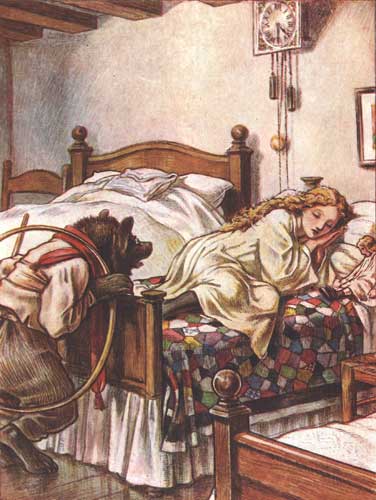
Goldilocks and the Bear by Paul Woodroffe

(The illustration is by Paul Woodroffe.)

Posted in Uncategorized | 12 Comments

Shoes of Bark

Shoes of Bark
by Theodora Goss

What would you think
if I told you that I was beautiful?
That I walked through the orchards in a white cotton dress,
wearing shoes of bark.

In early morning, when mist lingered over the grass,
and the apples, red and gold, were furred with dew,
I picked one, biting into its crisp, moist flesh,
then spread my arms and looked up at the clouds,
floating high above, and the clouds looked back at me.
By the edge of a pasture I opened milkweed pods,
watching the white fluff float away on the wind.

I held up my dress and danced among the chicory
under the horses’ mild, incurious gaze
and followed the stream along its meandering ways.

What would you think
if I told you that I was magical?
That I had russet hair down to the backs of my knees
and the birds stole it for their nests
because it was stronger than horsehair and softer than down.
That when the storm winds roiled,
I could still them with a word.

That when I called, the gray geese would call back
Come with us, sister, and I considered rising
on my own wings and following them south.

But if not me, who would make the winter come?
Who would breathe on the windows, creating landscapes of frost,
and hang icicles from the gutters?

What would you think, daughter, if I told you
that in a dress of white wool and deerhide boots
I danced the winter in?  And that in spring,
dressed in white cotton lawn, wearing birchbark shoes,
I wandered among the deer and marked their fawns
with my fingertips?  That I slept among the ferns?

Would you say, she is old, her mind is wandering?
Or would you say, I am beautiful, I am magical,
and go yourself to dance the seasons in?

(Look in my closet.  You will find my shoes of bark.)

Our Lady of the Cow Parsley by Elizabeth Sonrel

(The painting is Our Lady of the Cow Parsley by Elizabeth Sonrel.)

Posted in Uncategorized | 5 Comments

Diamonds and Toads

Diamonds and Toads
by Theodora Goss

This fairy tale is a metaphor.

Because it really would be just as uncomfortable
to have diamonds coming out of your mouth as toads:
one hard, sharp, like a mouthful of glass. The other
soft, squishy, making you
disgusted with yourself, because . . . toads!
Ugh. At least the diamonds are valuable,
glittering in the palm of your hand,
although their edges leave your throat aching,
your mouth sore.

The diamonds knock against your teeth.
The toads make your tongue feel coated
as though a snail had crawled across it,
leaving a trail.

Once there were two girls, sisters.
One, whose name was Tabitha,
woke up in a good mood. The sun was shining.
She did not mind the sheep
bleating in the meadow,
although some days she wished
they could be eaten by wolves
so it would be quiet, just for a moment.
Her dress was hanging in the closet,
freshly pressed (her sister had done the ironing
yesterday). Her hair was curling naturally,
rather than tangling in the brush, as usual.
So she sang as she went to the well.
There she met an old woman
who was secretly a witch. (Isn’t that how
it always goes?) The woman asked for water
and Tabitha gave it to her,
drawing up the pulley
with a smile and a “Lovely day, isn’t it?”
She’s the one who got the diamonds.

Her sister, Dolores,
woke up the next day with a headache.
It was raining, and rainy days always did that to her.
They also made her hair frizzy.
Her only clean dress
lay crumpled in the laundry basket, still damp
because Tabitha had forgotten to hang it on the clothesline.
(We can’t blame her. She was dealing
with the diamond problem, still lying down
with a hot compress on her throat.)
That morning, the breakfast porridge burned
and the cat had left a half-chewed mouse in the parlor.
Ugh. So Dolores went to the well
in a foul mood
and told the woman to draw up the water herself.
She got the toads.

I told you this tale is a metaphor.
They used the diamonds
to buy more dresses, a carpet for the parlor,
a phonograph, some sturdy shoes,
and books. Quite a lot of books.
Tabitha was able to finish her degree
in library science. Eventually
a prince proposed to Tabitha, but she didn’t want
to become his main source of income, better than taxes,
which parliament wouldn’t let him raise, so she told him
she wasn’t interested.

It was the toads that kept the garden
free of damaging insects: cutworms, leafrollers,
loopers, hornworms, rootminers, the ubiquitous beetles
that chew through rose leaves, leaving them
looking like window panes.
Dolores grew the finest cabbages, tomatoes,
aubergines. Her orchard was the only one
not devastated by a new apple borer.
Her roses were perfection.
From their hips she made a syrup for sore throats,
for which Tabitha was grateful.
She patented it and created a thriving business.

Eventually Dolores married a gentleman
with a very large garden. She’s Lady Dolores, now.
Tabitha became a librarian,
so she rarely has to talk:
she can shush without triggering the diamonds.
Still, she wears a spectacular brooch
pinned to her sweater, because after all, why not?

Here is the moral: there are circumstances
in which toads are as useful as diamonds.
Or it may be, try not to get out of bed
grumpy, especially when there are witches
around. Or always be nice to old women,
because you never know.
Or maybe Tabitha and Dolores are really
one woman, and some days what comes out of our mouths
is diamonds, and other days, toads.
Which is better? I don’t know.
The moral of a fairy tale
is as difficult to figure out as what to do
about cutworms and beetles, or blackspot
on the rose leaves.

Diamonds and Toads by Margaret Evans Price

(The illustration is by Margaret Evans Price.)

Posted in Uncategorized | 4 Comments

Death and the Maiden

Death and the Maiden
by Theodora Goss

The night has gathered around me. I think of Death,
who breathes so softly beside my ear, like a lover.
Softly he whispers, “This will soon be over.
You will lay those bones and heavy body down.”

I am in love with him because he holds me
so close, much closer than I have ever been held,
and I think that I will never again be cold,
although a wind is blowing in the darkness.

I worry that he does not seem to care
for the sorts of things I packed before I came here:
my friendships and memories. “What do they matter,” he asks,
“When you are resting safely in my arms?”

I put my bags on the bank beside the river
and answer him, as the night gathers around,
“Death, you are right. These things do not matter,
not here in your arms. Not here.”

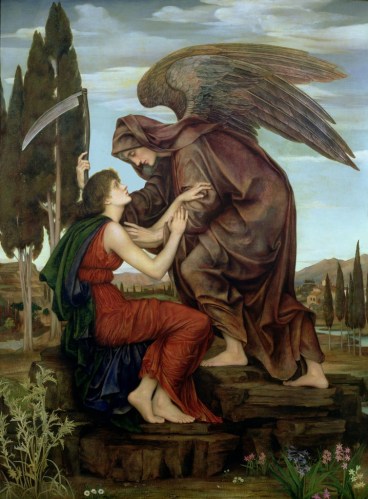
(The image is Angel of Death by Evelyn de Morgan. This poem was originally published in my poetry collection Songs for Ophelia, under the title “Death.”)

Posted in Uncategorized | 4 Comments

Sister Immaculata

Sister Immaculata
by Theodora Goss

Once, there was a woman
who did not want to get married.
Instead, she wanted to write.
What! said her father.
What! Why would you want such a thing?
said her mother, who had been married young
in the cathedral, wearing a long lace veil,
and borne seven children.
So the woman said
I will marry God.
Her parents nodded, because that
made sense: what woman
would not want such a husband?

Behind the stone walls of the convent,
she sits on her wooden chair,
beside her wooden bed, with its thin mattress,
under a crucifix with her husband
hanging on it,
and dips her pen into the ink
as though performing
a holy ritual.

Convent Thoughts by Charles Allston Collins

(The painting is Convent Thoughts by Charles Allston Collins. I wrote this poem after hearing about the seventeenth-century Mexican poet Sor Juana Inés de la Cruz, who decided to enter a convent instead of getting married so she could continue writing and studying scholarly works. I started wondering how many women made a similar choice, in eras when options for women were limited to marriage or the church.)

Posted in Uncategorized | 2 Comments