The Ophelia Cantos

The Ophelia Cantos
by Theodora Goss

I.

Lilies tangle in her hair: green stems
like water-snakes.

II.

A disembodied hand
floats on the surface. So much has been lost
already: toes, the lobe of her left ear.
But this remains, a damp, immaculate
sign, like a message saved from the dark current.

III.

She wandered through the courtyard in her tattered
dress distributing wild violets.
She called us whores — your son ma’am, not your husband’s
I think — and knaves — the taxes sir, your cellar
is stocked with sweet Moselle. We called this madness.

IV.

Indicia of her innocence: to be
a maiden floating dead among the flowers.

V.

She will become an elegant and mute
image: the sodden velvet coat, the sinking
coronet of poppies, virgin’s bower,
and eglantine. The replicable girl.

(A blob of Chinese white becomes a hand.
The artist puts his brush in turpentine,
the model pulls her stockings on.)

VI.

And yet,
surrounded by the water-lily stems,
her face appears an enigmatic mask:
a drowned Medusa in her snaking hair.
The lilies gape around her like pink mouths,
telling us nothing we can understand.

VII.

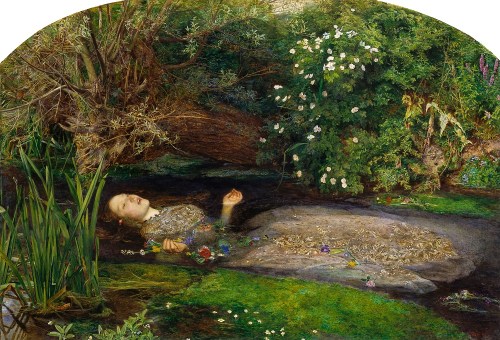
Her eyes stare upward: dead and not quite dead.

Ophelia by Sir John Everett Millais

(The painting is Ophelia by Sir John Everett Millais.  This poem was published in my poetry collection Songs for Ophelia.)

Posted in Uncategorized | Leave a comment

Gifts

Gifts
by Theodora Goss

Sometimes I consider the gifts I’ve been given:
life, first of all, then health, which lets me stride
through the world thoughtlessly — a little too much so.
Talent, I think, but that’s for you to decide.
An education my grandmother never imagined,
although she would be shocked I can’t embroider
a flower on a tablecloth while sitting properly
in an immaculate parlor. I’d like to show her
what I can do, despite my deficiencies — capture
flowers in a poem: turn roses into metaphor.
Wealth and security my grandfather,
who saw Budapest bombed in World War II,
never knew — he never even drove a car.
The question, of course, is what to do with these gifts,
although as far as I know they’re freely given,
no payment asked, as we are given rain.

And language, which I put on like a coat
of magic feathers in which I can fly,
feeling as though I’m up there with the geese
or Icarus, in the grand, dangerous sky,
thankful for the air supporting me,
thankful to the giver of gifts, who is also
the mother of poets. She made me what I am,
so this poem is itself a prayer — an inadequate one.

None of these are things I deserve or earned,
so I guess the best return I can make is to be
what she made me, however imperfectly: the person
who wrote this poem — a speck of dust, but singing.

The Reader by Arthur Meltzer

(The painting is The Reader by Arthur Meltzer.)

Posted in Uncategorized | 3 Comments

Foxes

Foxes
by Theodora Goss

Deep in the ferns they are creeping, their sweeping
tails setting swaying the ferns as they crawl,
little red foxes, an army of redcoats,
elegant-eared and cunningly small,
like rubies half-hid by a billowing shawl.

Deep in the ferns underneath the green forest,
on slender white ankles, with button-black eyes,
they swarm, and we catch just a glimpse in the half-light,
and hear through the thicket the witty wild cries
of those delicate, flashing, sanguineous spies.

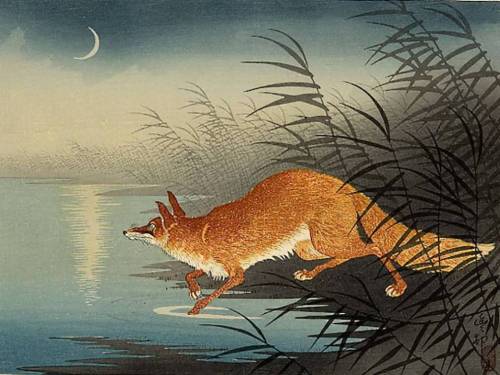
Fox in the Reeds by Ohara Koson

(The print is by Ohara Koson. This poem was published in my poetry collection Songs for Ophelia.)

Posted in Uncategorized | Leave a comment

The Certainty of Work

The Certainty of Work
by Theodora Goss

That night I lay in bed,
a compact bundle of nerve and muscle and bone,
under the coverlet,
wondering where my life was going
and where it had gone.

Feeling the darkness around me
promising nothing — no future except the dark
of the grave at last,
and until then, the certainty of work.
Work for pay, so I could have shelter and food,
and the truer work
that inheres in the bone and blood —
the work that is in me while I breathe
and write.

So I lay
alone with despair and hope
in the quiet night.

Print by Ohara Koson

(The print is by the Japanese artist Ohara Koson.)

Posted in Uncategorized | 2 Comments

The River’s Daughter

The River’s Daughter
by Theodora Goss

She walks into the river
with rocks in her pockets,
and the water closes around her
like the arms of a father
saying hello, my lovely one,
hello. How good to see you,
who have been away so long.

The eddying water
tugs at the hem of her dress,
and the small fish gather
to nibble at her ankles, at her knees,
to nibble at her fingers. They will find
it all edible, soon, except
the carnelian ring by which her sister
will identify her.

Bits of paper
float away, the ink now indecipherable.
Was it a note? Notes for another
novel she might have written, something new
to confound the critics? They will cling
to the reeds, will be used
to line ducks’ nests, with the down
from their breasts. The water
rises to her shoulders, lifts her hair.

Come, says the river. I have been waiting
for you so long, my daughter.
Dress yourself in my weeds,
let your hair float in my pools,
take on my attributes: fluidity,
the eternal, elemental flow
for which you always longed.
They are found not in words but water.
You will never find them while you breathe,
not in the world of air.

And she opens her mouth
one final time, saying father,
I am here.

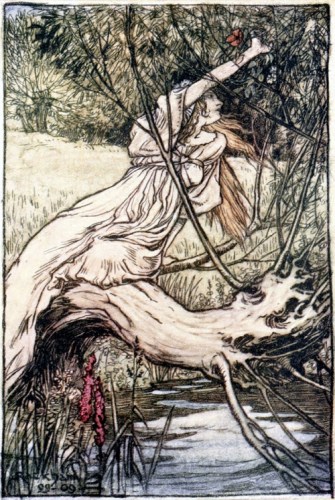
Ophelia by Arthur Rackham

(The image is of Ophelia by Arthur Rackham. But my poem was inspired by the story of Virginia Woolf, although it’s not meant to refer to her specifically.  It was published in my poetry collection Songs for Ophelia.)

Posted in Uncategorized | 2 Comments

Ugly

Ugly
by Theodora Goss

I think there should be two words that mean ugly,
because there are two kinds of ugliness.

The first kind is the ugliness of an ogre
whose nose resembles a turnip, with three hairs
on his chin as long and sharp as knitting needles
and teeth the color of piano keys —
the black ones. Or the witch in a ragged coat
who stands beside the road and poses riddles,
her voice a broken phonograph, skeletal hands
that clutch at you. Depending on how you answer
she will give you her little finger, cut with a knife
at the first joint, or send you on with a curse.
Her fingerbone will unlock your brother’s prison;
the curse will leave you lost, alone in the woods.
It’s the ugliness of an inn where pirates gather
to sign contracts in blood, swearing by the Devil.
Or marshes and waste spaces that have no use;
they stubbornly insist on remaining wild —
impassable bogs, thickets filled with thorns,
ruled by the spotted yellow queen of snakes.
It’s the ugliness of stepsisters chopping off
their toes for beauty, the beast with a warthog’s tusks
in a brocade waistcoat who slobbers on your hands
(which you belatedly realize is a kiss)
and asks you to marry him.

It’s the ugliness of a toadstool or a toad,
an honest ugliness. If you look closely,
you’ll see it’s more like beauty than you thought,
two sides of a coin, one polished, one rusted,
but the same coin: it will still buy you bread.

The second kind is the ugliness of a scar
where the forest has been cleared for electrical wires,
shining cables carried by metal giants,
an anthropomorphic army marching across
the landscape through suburbs of identical houses
with identical lawns — no hedges left for nests,
or holes for foxes, or undergrove where a doe
can hide her fawns. Until they reach a city
of concrete towers whose windows replace the stars
at night, or in the daytime become mirrors
in which we see only ourselves.

The first is an ugliness that makes us fear
or fight; the second fills us with despair
or indifference.

The word has a noble etymology:
from the Old Norse, in which”ugga” means “to dread,”
as we dread winter, lightning, or the gods.

I say we return the word to its ancient meaning
and use it only for what is truly dreadful:
let ugliness refer to toads and ogres
and choose another word for what we make
ugly and dull — too human, in our likeness
so when we look at the world, we see ourselves
reflected infinitely.

That way at least we’ll maintain a distinction
and understand what it is we’re talking about.
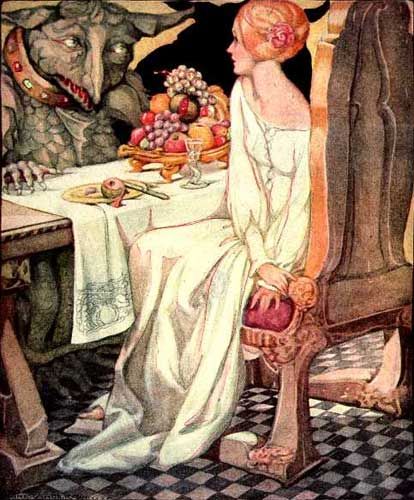
Beauty and the Beast by Anne Anderson

(The illustration is by Anne Anderson, for the fairy tale “Beauty and the Beast.”)

Posted in Uncategorized | 4 Comments

Dirge for a Lady

Dirge for a Lady
by Theodora Goss

Lay her in lavender, all that is left of her;
lavender preserves the lovely and the white.
Sweet clove and cinnamon, like a fine pomander,
lay her in these, the delicate, the slight.

Look how her hands are turned to alabaster,
translucent and tender, and breakable as pain.
Fine every filament, as though a thin spider
had woven her. She’s shattered, and will not arise again.

Rain, do not mourn her, nor rose adorn her.
How frail, this arrangement of elegant dry dust;
one breath would scatter her, one teardrop tatter her.
Think of her softly, and only if you must.

Lay her in lavender, all that is left of her.
Let nothing ravel the final webs of form,
where nor the rain nor roses come, a scented sepulcher,
airless and close, and infinitely calm.

Illustration for A Midsummer Night's Dream by Arthur Rackham

(The illustration is by Arthur Rackham for A Midsummer Night’s Dream. This poem was originally published in my collection Songs for Ophelia. It was also put to music by the British composer Brian Blyth Daubney and recorded on the CD October Roses.)

Posted in Uncategorized | Leave a comment