The Dragons

The Dragons
by Theodora Goss

One day, the dragons came.

It was on a Tuesday, she remembers. It was
the sort of thing that would happen on a Tuesday,
which is an unsatisfying sort of day,
not the beginning of the week, nor the middle,
without the anticipation of a Thursday.
A troublesome sort of day.

And there they were, sitting on the back porch railing,
where she had hung boxes for geraniums
that summer. But now, since it was November,
there were no geraniums — only dragons, quite small,
the size of a Pomeranian or Toy Poodle,
but of course with scales, which shone with a dim sheen
in the gray light of a rainy Tuesday morning.
Seven of them — green, blue, red, orange, another orange,
a sort of purple, and a white one that seemed smaller
than the others, the runt of the litter. It shone opalescent.
They were damp with rain, and obviously
too young to be out on their own. Had someone abandoned them,
the way people sometimes leave dogs at the edge of the woods?
Or were they feral, born to a wild mother?

She couldn’t just leave them there. As soon as they saw her,
the white one started a piteous baby roaring
and the green one joined in, showing the interior
of its pink mouth, like a geranium with teeth.
But when she opened the porch door, they just sat there,
staring at her with iridescent eyes.
What did dragons eat? She had no idea,
so she put half of last night’s Chinese takeout
in a bowl outside the porch door.
The rest she put into another bowl, inside
the open door, then went to get ready for work.
By the time she returned, in her suit and sensible pumps,
they were curled up on the sofa, already asleep,
except for the blue one, which hissed at her, not in anger,
she thought, but simply to let her know it was there.
The bowls were empty.

They continued to be trouble.
The orange one burned a hole in the carpet, or was it
the other orange one? They were so similar,
initially she could not tell them apart.
But eventually she learned to distinguish them
by their quirks and personalities —
one was just playful, the other more mischievous.
She gave them all names: Hyacinth (that was the purple),
Orlando, Alexander (after her brother,
who was a software designer in San Francisco
and sent her pictures at Christmas of his apartment
decorated with plastic poinsettia).
Ruby (a little too obvious, but it suited her),
Dolores and Delilah (the orange ones),
and little Cordelia, the runt, who affectionately
clawed apart her favorite afghan
while trying to climb the armchair into her lap.
She tried calling the ASPCA
and the local veterinary clinics, but no one was missing
a clutch of dragons. The receptionist at one clinic
thought she meant geckos.
What in the world was she supposed to do with them?
The nearest shelter said it had no facilities
for dragons, sounding a little incredulous
over the phone. Meanwhile, they scratched the furniture,
got tangled in the hangers while creating
a nest in her closet of scarves and pantyhose.
She could not leave out a pair of earrings, or coins
in a jar for laundry and parking — anything shiny.
They would begin to hoard it, hissing at her
when she approached to take back her watch or car keys.
Her bills for Chinese takeout
were astronomical.

She took sick leave when Orlando and Alexander
both caught pneumonia and had to be nursed back to health.
(She finally found a vet who would treat dragons,
a younger guy trying to establish a practice.)
“I’m not sure about dosage,” he said, as he gave her
a prescription for antibiotics. “About the same
as for a golden retriever? But it’s just a guess.
Aren’t they getting a little big, for a place
of this size?” And she had to admit he was right.
Now when Ruby curled up next to her
as she watched Casablanca, the red dragon
took up half the sofa. Her sort-of-boyfriend,
Paul, who worked in the tax and bankruptcy group,
started complaining. She understood his perspective —
the dragons had never liked him. Hyacinth
always bellowed when he came over, Delilah
peed on his baseball cap, and Dolores chewed
a corner of his briefcase. “They’re dragons,” he told her.
“They’re dangerous — what if they bite someone? You’d have
a lawsuit on your hands. I really don’t know
why you keep them around.”
Probably because they were warm at night,
piled on her bed, with Cordelia’s silky muzzle
tucked under her chin. Whenever she got home
after a long day at the office, they greeted her,
trilling in unison. They never told her
that her hairstyle didn’t fit the shape of her face,
or she really should lose a few pounds, unlike her mother.
They never asked her to file incorporation
documents yesterday, or talked to her
for an hour about baseball while she was trying to listen
to NPR. Anyway, who would take them,
all seven of them? Dragons don’t make good pets,
and she hated the thought of separating them.
They needed each other.

Finally, she moved to a lighthouse in New England.
She saw the advertisement — Lighthouse keeper
wanted. Must be willing to live on an island
off the coast of Maine, near Portland. Competitive salary.

The ferry comes twice a week. She can take it to Portland
if she wants to, but it brings everything she needs,
from lightbulbs to chocolate chip cookies to art supplies.
Sometimes she goes, just to get Chinese takeout.
The dragons have learned to fish and fend for themselves.
She watches them flying up in the sky like kites
when she goes on her morning walk, collecting shells
and bits of seaglass. Mostly they stay outdoors,
but Cordelia still sleeps in the bed beside her at night,
stretched out on the blanket. She has not grown much larger
than a Great Dane, although Alexander is now
the size of a Volkswagen Beetle. On sunny mornings
she finds them lying on the rocky shore, like seals,
shining in the sunlight. On rainy days, there’s a cave
on the other side of the island, although Dolores
curls up in the lighthouse itself, around the beacon.
On stormy nights, she’s seen them guide a ship
to shore, which seems an unusual behavior, but dolphins
do it, so why not dragons?
She’s started painting again, the way she used to
when she was a teenager, before her father
told her to focus on something more practical.
Her canvases sell in a gallery and on her website.
Mostly, she paints the dragons — rolling around
in the waves, lying on the shore, cavorting above
in intricate arabesques, as if they knew
she was sketching below, showing off for her.

She doesn’t make as much money
as she did at the law firm. But then, on the other hand,
she has dragons.

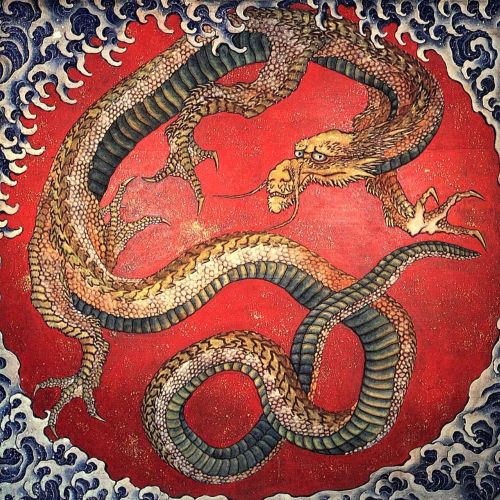
(The image is a painting of a dragon by Hokusai.)

Posted in Uncategorized | 6 Comments

Hungarian Songs

Hungarian Songs
by Theodora Goss

I want to tell a story about the hills
that Hungarians call mountains
known as the Mátra, which is a mountain range
or a ridge of hills, depending on where you come from,
and a particular hill (or mountain) from which you can see
forever, or at least as far as the next hillside.
On it grow wildflowers, and among the wildflowers
grow butterflies, some orange with brown spots,
some white with orange spots, some green,
and grasshoppers. If you sit there quietly,
you can hear the birds in the forest,
and the wind in the leaves, and the crickets,
all singing to you, each singing their distinctive
songs, which are as old as the hills
(or mountains) and untranslatable
from the original Hungarian.

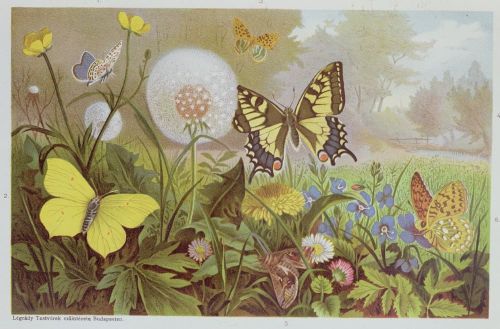
(The image is an illustration of butterflies from a Hungarian book on natural history.)

Posted in Uncategorized | Leave a comment

The Headless Jesus

The Headless Jesus
by Theodora Goss

There was a tomb in the Fiume Road Cemetery
in Budapest, on which a headless Jesus sat
between two angels holding up their arms
to Heaven as though they too were wondering
where his stone head had gone. No doubt
someone had stolen it sometime in the last century,
perhaps in the infamous 1970s
when these sorts of things would happen
(it was a godless age), and now his head was sitting
in an antique shop or perhaps in someone’s library
as an example of nineteenth-century stonework,
looking up with its compassionate stone eyes
at an electric light bulb, vaguely remembering the sky
it had once watched, the movement of clouds,
the feel of rain on its stone cheeks, the rustle of wind
in the leaves of the sycamore trees, and the crows,
black and gray like an order of monks,
that would perch on the stone wall above, cawing
about something important, probably politics —
missing the sooty air of Budapest
and the sound of trams along Fiume Road
and the company of its stone angels.

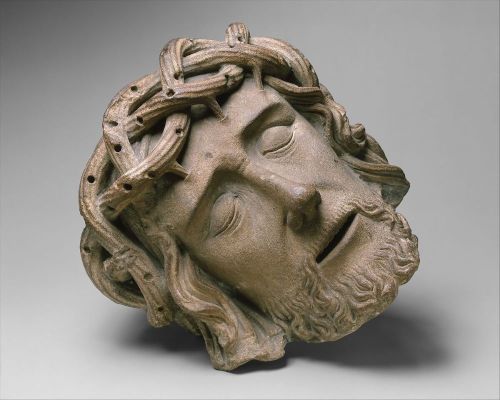
(The image is Head of Christ by an unknown sculptor.)

Posted in Uncategorized | Leave a comment

Little Apples

Little Apples
by Theodora Goss

I gathered the little apples even though the wasps
told me the apples were theirs. They would alight
on an apple, a ripe one of course, and suck
out its sweetness. Under the tree, the overripe ones
lay on the grass, striped red and orange,
with an intriguing variety of bruises, smelling
too sweet, eau de pomme trop mûres, the perfume
of autumn. I chose from among the ones
still on the tree, still partly green, but already
turning red, freckled and striated, twisting
their stems until they detached, deciding
if they were not sweet enough, I would turn them,
chopped and simmered to the color of honey,
into compote with a bit of cane sugar,
then ladle them into glass bottles, keeping
the apples that way, not letting this perfect autumn
escape from me, not letting our time together
escape from me, like a wasp forever in amber.

(The image is Basket of Apples by Claude Monet.)

Posted in Uncategorized | Leave a comment

Sorrow Song

Sorrow Song
by Theodora Goss

Sorrow, Sorrow, come to me,
comb my hair,
lay out the dress I planned
to wear.
Let it be my wedding dress
or my shroud.
Luckily, white linen
does not fade.
Walk with me, hand in hand,
by the sea shore,
collecting multicolored shells,
watching the billows and the swells
as the waves cast their spells –
listening to the song they sing,
beckoning, beckoning,
like the song you sang
so long ago
as you rocked my cradle,
dear Sorrow.

(The image is On the Seashore by George Elgar Hicks.)

Posted in Uncategorized | 2 Comments

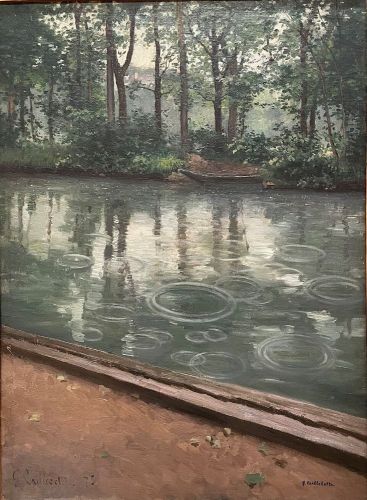
The Pond Beneath the Willows

The Pond Beneath the Willows
by Theodora Goss

I found a secret pond beneath the willows
where the ground was carpeted with creeping charlie.
Reeds grew around it, and in the lake beyond
were the leaves, floating on the water, of waterlily.
The rain dripped from the willows, slowly, slowly,
starting ripples like in that painting by Caillebotte,
and I thought that everything in nature is perfect, really,
whether or not you can capture it in art.
For a moment I felt as close to true contentment
as I think is possible on this troubled Earth,
and I did not care about things like death or dinner
while raindrops fell in plonking quarter notes
and the crickets began their chirping, and the hidden birds
called to each other, saying the storm was done,
and I stood for a while in that resplendent stillness,
and I did not want to go home.

(The image is The Yerres, Effect of Rain by Gustave Caillebotte)

Posted in Uncategorized | 2 Comments

Theoretical Physics

Theoretical Physics
by Theodora Goss

Maybe gravity
is how the Earth loves us,
holding on to us,
bringing us back to her
no matter how high we jump
or fly, like a careful mother
with her arms stretched out,
always catching us,
as she continually catches
avalanches and waterfalls,
and every seed that journeys
on the billows of the air,
and rain returning from the clouds,
and every leaf that floats
from among the branches to lie
upon the grass, and every blossom,
and even the birds,
with their illusion of perpetual rising,
even eventually her own daughter,
the rebellious moon,
who left home so long ago,
always bringing us
back into her arms,
back into her embrace.

(The image is A Dark Pool by Laura Knight.)

Posted in Uncategorized | 1 Comment