Shoes of Bark

Shoes of Bark
by Theodora Goss

What would you think
if I told you that I was beautiful?
That I walked through the orchards in a white cotton dress,
wearing shoes of bark.

In early morning, when mist lingered over the grass,
and the apples, red and gold, were furred with dew,
I picked one, biting into its crisp, moist flesh,
then spread my arms and looked up at the clouds,
floating high above, and the clouds looked back at me.
By the edge of a pasture I opened milkweed pods,
watching the white fluff float away on the wind.

I held up my dress and danced among the chicory
under the horses’ mild, incurious gaze
and followed the stream along its meandering ways.

What would you think
if I told you that I was magical?
That I had russet hair down to the backs of my knees
and the birds stole it for their nests
because it was stronger than horsehair and softer than down.
That when the storm winds roiled,
I could still them with a word.

That when I called, the gray geese would call back
Come with us, sister, and I considered rising
on my own wings and following them south.

But if not me, who would make the winter come?
Who would breathe on the windows, creating landscapes of frost,
and hang icicles from the gutters?

What would you think, daughter, if I told you
that in a dress of white wool and deerhide boots
I danced the winter in?  And that in spring,
dressed in white cotton lawn, wearing birchbark shoes,
I wandered among the deer and marked their fawns
with my fingertips?  That I slept among the ferns?

Would you say, she is old, her mind is wandering?
Or would you say, I am beautiful, I am magical,
and go yourself to dance the seasons in?

(Look in my closet.  You will find my shoes of bark.)

Our Lady of the Cow Parsley by Elizabeth Sonrel

(The painting is Our Lady of the Cow Parsley by Elizabeth Sonrel.)

Posted in Uncategorized | 5 Comments

Diamonds and Toads

Diamonds and Toads
by Theodora Goss

This fairy tale is a metaphor.

Because it really would be just as uncomfortable
to have diamonds coming out of your mouth as toads:
one hard, sharp, like a mouthful of glass. The other
soft, squishy, making you
disgusted with yourself, because . . . toads!
Ugh. At least the diamonds are valuable,
glittering in the palm of your hand,
although their edges leave your throat aching,
your mouth sore.

The diamonds knock against your teeth.
The toads make your tongue feel coated
as though a snail had crawled across it,
leaving a trail.

Once there were two girls, sisters.
One, whose name was Tabitha,
woke up in a good mood. The sun was shining.
She did not mind the sheep
bleating in the meadow,
although some days she wished
they could be eaten by wolves
so it would be quiet, just for a moment.
Her dress was hanging in the closet,
freshly pressed (her sister had done the ironing
yesterday). Her hair was curling naturally,
rather than tangling in the brush, as usual.
So she sang as she went to the well.
There she met an old woman
who was secretly a witch. (Isn’t that how
it always goes?) The woman asked for water
and Tabitha gave it to her,
drawing up the pulley
with a smile and a “Lovely day, isn’t it?”
She’s the one who got the diamonds.

Her sister, Dolores,
woke up the next day with a headache.
It was raining, and rainy days always did that to her.
They also made her hair frizzy.
Her only clean dress
lay crumpled in the laundry basket, still damp
because Tabitha had forgotten to hang it on the clothesline.
(We can’t blame her. She was dealing
with the diamond problem, still lying down
with a hot compress on her throat.)
That morning, the breakfast porridge burned
and the cat had left a half-chewed mouse in the parlor.
Ugh. So Dolores went to the well
in a foul mood
and told the woman to draw up the water herself.
She got the toads.

I told you this tale is a metaphor.
They used the diamonds
to buy more dresses, a carpet for the parlor,
a phonograph, some sturdy shoes,
and books. Quite a lot of books.
Tabitha was able to finish her degree
in library science. Eventually
a prince proposed to Tabitha, but she didn’t want
to become his main source of income, better than taxes,
which parliament wouldn’t let him raise, so she told him
she wasn’t interested.

It was the toads that kept the garden
free of damaging insects: cutworms, leafrollers,
loopers, hornworms, rootminers, the ubiquitous beetles
that chew through rose leaves, leaving them
looking like window panes.
Dolores grew the finest cabbages, tomatoes,
aubergines. Her orchard was the only one
not devastated by a new apple borer.
Her roses were perfection.
From their hips she made a syrup for sore throats,
for which Tabitha was grateful.
She patented it and created a thriving business.

Eventually Dolores married a gentleman
with a very large garden. She’s Lady Dolores, now.
Tabitha became a librarian,
so she rarely has to talk:
she can shush without triggering the diamonds.
Still, she wears a spectacular brooch
pinned to her sweater, because after all, why not?

Here is the moral: there are circumstances
in which toads are as useful as diamonds.
Or it may be, try not to get out of bed
grumpy, especially when there are witches
around. Or always be nice to old women,
because you never know.
Or maybe Tabitha and Dolores are really
one woman, and some days what comes out of our mouths
is diamonds, and other days, toads.
Which is better? I don’t know.
The moral of a fairy tale
is as difficult to figure out as what to do
about cutworms and beetles, or blackspot
on the rose leaves.

Diamonds and Toads by Margaret Evans Price

(The illustration is by Margaret Evans Price.)

Posted in Uncategorized | 4 Comments

Death and the Maiden

Death and the Maiden
by Theodora Goss

The night has gathered around me. I think of Death,
who breathes so softly beside my ear, like a lover.
Softly he whispers, “This will soon be over.
You will lay those bones and heavy body down.”

I am in love with him because he holds me
so close, much closer than I have ever been held,
and I think that I will never again be cold,
although a wind is blowing in the darkness.

I worry that he does not seem to care
for the sorts of things I packed before I came here:
my friendships and memories. “What do they matter,” he asks,
“When you are resting safely in my arms?”

I put my bags on the bank beside the river
and answer him, as the night gathers around,
“Death, you are right. These things do not matter,
not here in your arms. Not here.”

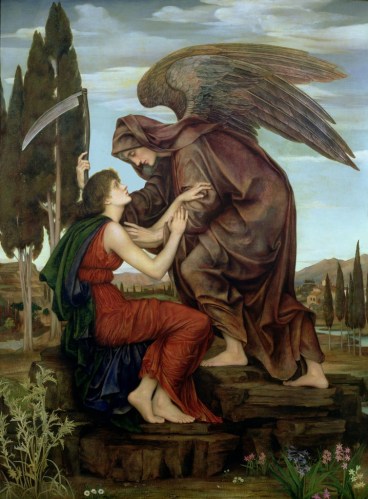
(The image is Angel of Death by Evelyn de Morgan. This poem was originally published in my poetry collection Songs for Ophelia, under the title “Death.”)

Posted in Uncategorized | 4 Comments

Sister Immaculata

Sister Immaculata
by Theodora Goss

Once, there was a woman
who did not want to get married.
Instead, she wanted to write.
What! said her father.
What! Why would you want such a thing?
said her mother, who had been married young
in the cathedral, wearing a long lace veil,
and borne seven children.
So the woman said
I will marry God.
Her parents nodded, because that
made sense: what woman
would not want such a husband?

Behind the stone walls of the convent,
she sits on her wooden chair,
beside her wooden bed, with its thin mattress,
under a crucifix with her husband
hanging on it,
and dips her pen into the ink
as though performing
a holy ritual.

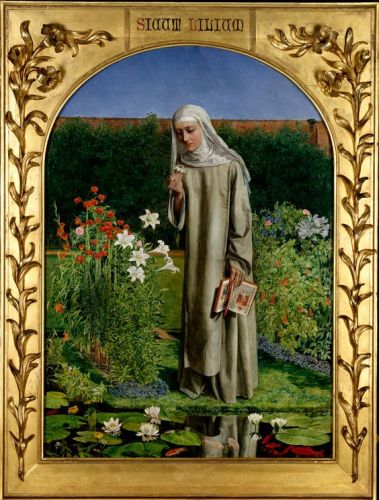
Convent Thoughts by Charles Allston Collins

(The painting is Convent Thoughts by Charles Allston Collins. I wrote this poem after hearing about the seventeenth-century Mexican poet Sor Juana Inés de la Cruz, who decided to enter a convent instead of getting married so she could continue writing and studying scholarly works. I started wondering how many women made a similar choice, in eras when options for women were limited to marriage or the church.)

Posted in Uncategorized | 2 Comments

The Ophelia Cantos

The Ophelia Cantos
by Theodora Goss

I.

Lilies tangle in her hair: green stems
like water-snakes.

II.

A disembodied hand
floats on the surface. So much has been lost
already: toes, the lobe of her left ear.
But this remains, a damp, immaculate
sign, like a message saved from the dark current.

III.

She wandered through the courtyard in her tattered
dress distributing wild violets.
She called us whores — your son ma’am, not your husband’s
I think — and knaves — the taxes sir, your cellar
is stocked with sweet Moselle. We called this madness.

IV.

Indicia of her innocence: to be
a maiden floating dead among the flowers.

V.

She will become an elegant and mute
image: the sodden velvet coat, the sinking
coronet of poppies, virgin’s bower,
and eglantine. The replicable girl.

(A blob of Chinese white becomes a hand.
The artist puts his brush in turpentine,
the model pulls her stockings on.)

VI.

And yet,
surrounded by the water-lily stems,
her face appears an enigmatic mask:
a drowned Medusa in her snaking hair.
The lilies gape around her like pink mouths,
telling us nothing we can understand.

VII.

Her eyes stare upward: dead and not quite dead.

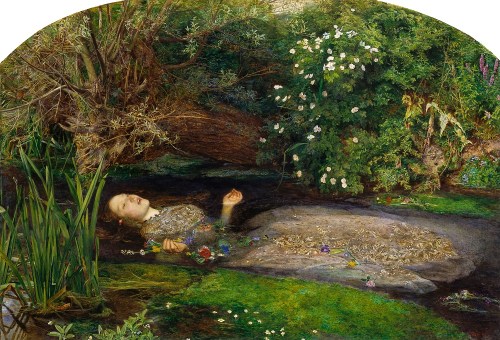
Ophelia by Sir John Everett Millais

(The painting is Ophelia by Sir John Everett Millais.  This poem was published in my poetry collection Songs for Ophelia.)

Posted in Uncategorized | Leave a comment

Gifts

Gifts
by Theodora Goss

Sometimes I consider the gifts I’ve been given:
life, first of all, then health, which lets me stride
through the world thoughtlessly — a little too much so.
Talent, I think, but that’s for you to decide.
An education my grandmother never imagined,
although she would be shocked I can’t embroider
a flower on a tablecloth while sitting properly
in an immaculate parlor. I’d like to show her
what I can do, despite my deficiencies — capture
flowers in a poem: turn roses into metaphor.
Wealth and security my grandfather,
who saw Budapest bombed in World War II,
never knew — he never even drove a car.
The question, of course, is what to do with these gifts,
although as far as I know they’re freely given,
no payment asked, as we are given rain.

And language, which I put on like a coat
of magic feathers in which I can fly,
feeling as though I’m up there with the geese
or Icarus, in the grand, dangerous sky,
thankful for the air supporting me,
thankful to the giver of gifts, who is also
the mother of poets. She made me what I am,
so this poem is itself a prayer — an inadequate one.

None of these are things I deserve or earned,
so I guess the best return I can make is to be
what she made me, however imperfectly: the person
who wrote this poem — a speck of dust, but singing.

The Reader by Arthur Meltzer

(The painting is The Reader by Arthur Meltzer.)

Posted in Uncategorized | 3 Comments

Foxes

Foxes
by Theodora Goss

Deep in the ferns they are creeping, their sweeping
tails setting swaying the ferns as they crawl,
little red foxes, an army of redcoats,
elegant-eared and cunningly small,
like rubies half-hid by a billowing shawl.

Deep in the ferns underneath the green forest,
on slender white ankles, with button-black eyes,
they swarm, and we catch just a glimpse in the half-light,
and hear through the thicket the witty wild cries
of those delicate, flashing, sanguineous spies.

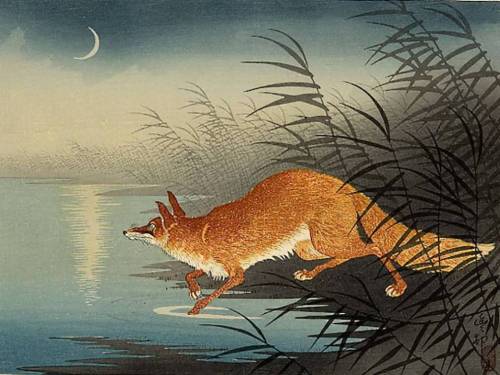
Fox in the Reeds by Ohara Koson

(The print is by Ohara Koson. This poem was published in my poetry collection Songs for Ophelia.)

Posted in Uncategorized | Leave a comment