The Nightingale and the Rose
by Theodora Goss
Here is the story:
There was a nightingale.
She looked like nothing at all,
a small brown bird
perched in the rose bushes.
You would scarcely have seen her
unless you were looking carefully.
The roses were still blooming
although it was late summer:
they were hybrid perpetuals, bred
from the old French roses
crossed with roses from China
brought back by sailors and diplomats,
in cargoes with blue porcelain
and embroidered silk.
The nightingale did not know this:
she had not migrated so far.
What she knew was her nest in the thicket
by the orchard, with two eggs in it the size
of your thumbnail, speckled brown.
What she knew was the professor’s garden:
the elm tree, the fountain in which she bathed,
shaking her feathers. The sundial
that told the time and all the local gossip.
The green lizards sunbathing on the wall,
the tennis lawn, the roses in clipped rows,
already losing their petals,
yellow and pink, pink striped red,
apricot, and cream with a yellow heart.
She knew they cost a great deal, for the professor
had said so, walking in the garden
with the university chancellor,
and the lizards had repeated it.
She knew the student who lived with the professor
in a rented room and sometimes left his books
on the garden bench. She knew he was studying
something called metaphysics.
She knew the professor’s daughter,
who walked in the garden and often sang to herself
while cutting flowers — not quite as well
as a nightingale, but one must make allowances.
Anyway, the nightingale thought she was beautiful,
with rich brown hair. But the butterflies
thought she was ugly, so large and human,
always taking away the flowers
so they could be displayed in vases behind glass windows,
and what was the use of that? They were convinced
the flowers belonged to them. After all,
they were the ones who depended on the nectar
for food. They were socialists.
One day as she sat in her nest, the nightingale heard
the student complaining to the lizards, or perhaps to the wall:
She promised to dance with me if I brought her a red rose
to match her dress, but there are no red roses,
only pink streaked with red, or red on the yellow petals.
The lizards scurried along the wall. They did not care
about the student’s relationship problems.
But the nightingale was a romantic.
I shall find him a red rose, she thought.
The student was right: there were no red roses,
not anywhere in the professor’s garden.
Why do you want a red rose? asked the Boule de Neige.
It was the most beautiful rose in the garden, and knew it.
Its buds were red, but opened into white globes
of fragrance. A white rose means innocence,
a white rose means I am pure.
Because the professor’s daughter wants it, said the nightingale.
And red roses mean love. That’s what she truly wants: proof
that the student loves her. And then perhaps
she will permit herself to love him back. Can you not turn
your petals red? For love
is the best thing in the world. Or what she had seen
of the world, from Denmark to the coast of Africa.
She had migrated once already.
Look how the sun loves the waterdrops
that splash from the fountain,
how the wind loves the top of the elm tree,
how the lizards love their wall. That is how
the student loves the professor’s daughter,
I’m sure of it.
There is only one way to turn a white rose red,
said the Boule de Neige. And it is so terrible
that I do not want to mention it.
Tell me, said the nightingale.
I’m not afraid.
You see that rose? My most beautiful rose
at the end of an arching cane. If you perch
on that cane and put your breast against the thorn,
then press on it, so it drinks of your heart’s blood,
and you sing — remember that you must sing —
slowly the rose will turn red.
The nightingale chirped
and flitted about in her agitation.
But my heart’s blood — will I not die?
She thought of her eggs, her precious eggs,
speckled brown, the size of your thumbnail.
She loved her eggs, as much as the student
loved metaphysics. They had been laid in June,
for she had mated late. In a few days
they would hatch.
That I can’t tell you, said the Boule de Neige.
Very likely, but one must take risks for love,
or so I have heard.
I don’t know, I don’t know, said the nightingale.
Let me return this evening. I must consider
all the option.
The rest of that day, she sat on her eggs.
What if she never came back, and they did not hatch?
What if they hatched and she was not there
when her children called for her? Who would teach them to fly?
It was the male nightingales, after all, who sang at night,
as her mate had sung to her before an owl
had made a meal of him. Who was she
to do this?
And yet she could already imagine
the red rose, the most beautiful of all roses,
that her song would produce.
She felt this task had been given to her.
In all the garden, only she
could sing a red rose into being.
That evening, as the moon climbed the sky,
she left her nest in the thicket and flew to the rose bushes.
She perched on the arching cane with the most beautiful rose
on it, white as snow. I’m ready, she said.
All right, said the Boule de Neige. We shall do this together.
She put her breast on the thorn so it pierced deeply
and sang. She sang all the songs she had learned
since she had hatched from an egg —
songs of courtship, songs of warning, songs about rain,
songs that meant The cat is coming.
The lizards said, what is that racket? But the sundial
liked it, and the fountain accompanied her as well as it could,
and the other rose bushes, who knew what was happening,
listened intently: the Variegata de Bologna,
the Reine des Violettes, the Souvenir de la Malmaison,
who claimed descent from Empress Josephine herself.
Even the daisies in the tennis lawn understood
and blushed to be witnessing an event so important.
The student up in his garret bedroom
said, How prettily the nightingale is singing!
as he leafed through his Kant and Hegel.
Only the professor’s daughter did not hear it,
for she was practicing at the pianoforte
and anyway the French doors were closed.
All night long the nightingale sang,
and by morning the rose was as red as her heart’s blood,
as red as the velvet mantle of a king,
or a ruby worn by an American heiress.
Even the dawn was astonished
and touched it delicately.
But what about the nightingale? She lay
on the rich soil of the rose bed,
her small heart barely beating. Had it been worth it?
She thought it had, she was almost certain.
For during that long night it had come to her
that the rose, despite being beautiful, was beside the point.
For the point — and here she gasped, her beak open
to take a final breath — was the song, and becoming the song.
Before breakfast, the student walked into the garden.
A red rose! And the most magnificent one
he had ever seen. Surely she would dance with him now
at the party the professor was throwing that evening
for his department. There would be a waltz, he was sure of it.
He would hold her tightly around the waist, and she would dance
with him, and maybe kiss him in the conservatory.
Look, he said, showing it to her
over toast and marmalade in the breakfast room.
It will match your dress perfectly.
Oh, she said. But I’m not wearing that dress anymore.
Where had he found the rose? She had asked for a red one
because there were none in the garden. Tonight, she was planning
to slip away during the mazurka, when no one would notice,
and elope with her cousin, whom she had loved since they were children
spending summers together at their grandparents’ house in Funen.
Her father had quarreled with his father and forbidden her
to see him, so they had been meeting in secret.
She wore his engagement ring on a chain under her bodice.
Tomorrow they would be married. They were risking
everything — the anger of their fathers, disinheritance.
But at least they would be together.
She did not want the student searching for her at the party,
preventing her escape. Why could he not have fallen
in love with someone else, like the kitchen maid?
Later the student, despondent,
on his way to the university, discovered
that he had inadvertently tucked the rose into his satchel,
not knowing what else to do with it.
With an oath he flung it into the street,
where a cartwheel ran over it
and a horse’s hooves trampled it
into the mud. Love is a fool’s game,
he thought. Better stick
with what can be learned in books.
That night, after the party was over,
the professor snoring in his nightcap, the student
sprawled on his bed, still in his clothes
(he would have a hangover the next morning),
the professor’s daughter in a coach rolling toward Copenhagen,
her head on her cousin’s shoulder, the marriage license
tucked safely in his waistcoat pocket, only the kitchen maid
still awake, washing the last of the coffee cups,
Mother Night came walking down the street.
The pear and quince trees in the orchard bowed,
as did the elm. The fountain spit its waters
as hard and high as it could so the drops would sparkle
like fireworks under the moon. The daisies
grew pale — they were very young. The rose bushes,
who were well-bred, bent their canes gracefully.
Even the lizards, despite being diurnal, blinked their eyes
in the moonlight. And the old house itself, which had stood
since before the Reformation, said to her,
Lady, I am not worthy
of this honor.
She smiled and said, I believe you have something here
that was made for me? Ah, yes.
She stooped in the street, on which the mud had dried,
and picked up the rose, crushed, its petals scattered.
then put it into her dark hair, fastening it
with a jeweled pin. There, it blossomed
and its fragrance filled the garden. In that house
all the sleepers, from the professor to the cook,
would have strange dreams.
She stroked the timbers of the house, which creaked with pleasure,
then scratched the lizards under their chins. To the roses,
she nodded, as great ladies nod to each other,
and they nodded back, knowingly. She smiled
at the daisies, who immediately closed up with shyness.
Finally, she lifted the nightingale, lying
stiff and lifeless, then breathed on her, long and slow.
The nightingale gasped and fluttered. When she saw
the face bent over her,
she hid her head beneath her wing.
Such humility, said Mother Night. And in a great artist.
Would you like to sing in my garden at the end of the world?
The nightingale, not knowing what to say,
gave one small trill, but that was enough.
Pardon me, said Mother Night to the wall,
reaching into the thicket and lifting the nightingale’s nest,
then putting the nightingale on her speckled eggs. Carrying
the nest in the palm of her hand, she proceeded up the street,
for she had a great deal to do before sunrise.
In Paris she picked up a poet
who had died that day of meningitis
in a hotel room, after being released from prison.
She put him into her pocket, already filled
with all the oddments she had collected that night.
Still carrying the nightingale’s nest,
she walked to the end of the world, to her house
of many rooms, some large as the sky,
some small as a mouse hole,
where everything precious is preserved.
If you ever find it — it’s not on any map
and you can only go there by invitation —
sit in the garden, just at twilight,
and hear the nightingales. There are three of them.
They are said to be very fine.
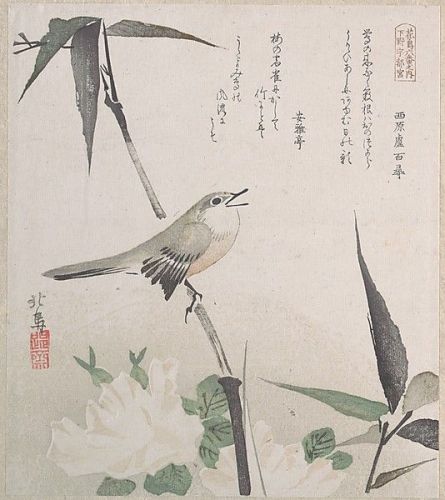
(The image is by the Japanese artist Teisai Hokuba. This poem is based on the fairy tale of the same name by one of my favorite writers, Oscar Wilde. In it, I tried to answer some of the questions I had after reading the fairy tale and teaching it in one of my classes.)




 Theodora Goss: Poems