The Red Lilies

The Red Lilies
by Theodora Goss

This morning, the lilies are on fire,
metaphorically.

I don’t know where such passion comes from,
unless maybe they’re in love with the light
falling on them through the window:
a cold winter light, gray and blue,
in which the lilies are blazing.

Eventually, they’ll burn themselves out.
But meanwhile, I’m warming my hands by them,
which is a bit dangerous. If I get too close
and singe my fingers, and later people ask
what happened, I’ll have to explain
it was an accident, that I caught fire from the lilies
on my dining room table.

Every week, I buy myself flowers
at the market for three dollars a bunch:
Peruvian lilies, which are practical, they last so long,
especially if you remember to change the water.
But I never considered they could ignite,
even if only metaphorically.

Although people have died of metaphor.

Poetry is no safer than these lilies,
arranged in a green and gray pottery jar
on a lace doily crocheted by my grandmother.
Get too close, you will inevitably
start to burn.

Vase with Red Gladioli by Vincent Van Gogh

(The image is Vase with Red Gladioli by Vincent Van Gogh, which is the closest I could come to red lilies . . .)

Posted in Uncategorized | 2 Comments

Valentine’s Day

Valentine’s Day
by Theodora Goss

This is the coldest day of the year so far —
the kind of cold that hurts you to the bone,
that says to impatient bulbs, stay underground:
the world is dead, there’s nothing for you here.

And yet this is the day we’ve chosen to be
our Valentine, instead of some day in June
when birdsong would wake us, not this bitter cold —
when roses would actually be blooming. Crazy, isn’t it?

The thing is, we like to believe in what we can’t see,
we crazy humans. That bulbs will be daffodils
and crocuses, that those sticks poking out of the ground,
half-covered in burlap, are actually rose bushes,

that the warblers and wrens who are having a grand old time
in Mexico will decide to return again.
We believe in spring, we believe in promises,
we talk about love, that insubstantial notion,

convinced that it will sprout from the cold ground.
We are, all of us, incurable romantics.
And yet, before the snow fell, I could see,
poking out of the ground, a few green shoots.

I know they’re there, just waiting for a finger
of warmth to touch them. And when that delicate girl,
the spring, with sunlit hair, returns again
from wherever she’s been vacationing, they’ll grow,

filling our world with colors and fragrances.
We’ll forget our frostbitten cheeks, the icy sidewalks.
For now? We wrap ourselves in scarves and curse
the wind, and slip on ice, and talk about love,

convinced that it exists although we can’t see it —
hopeful or delusional, which may be
much the same thing. Meanwhile the world around us
lies (at least we hope) not dead but sleeping . . .

Illustration by Walter Crane

(The illustration is by Walter Crane.)

Posted in Uncategorized | Leave a comment

Chrysanthemums

Chrysanthemums
by Theodora Goss

These are the ragged flowers
present at every gravesite.

Imagine a cloud of petals
like a ruffled cockatoo,
like a slice of wedding cake
with the narrow end eaten,
a pile of lace with leaves
as tough as a toad’s skin,
smelling of aniseed.
We give these to the dead.

As they go into the darkness,
the heads of chrysanthemums
must light their way, like lamps.

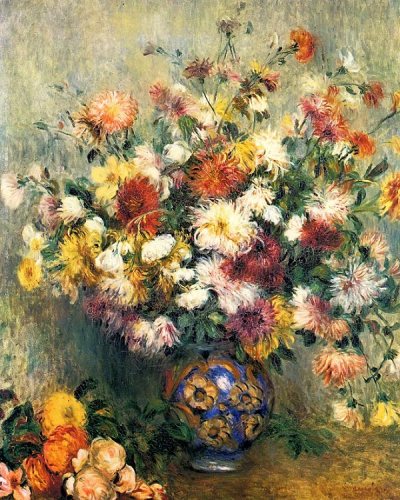
Bouquet of Chrysanthemums by Pierre-Auguste Renoir

(The painting is Bouquet of Chrysanthemums by Pierre-Auguste Renoir.)

Posted in Uncategorized | Leave a comment

Water Lilies, 1907

Water Lilies, 1907
by Theodora Goss

When he painted them,
was he tired? Did he have to brush away
a hovering dragonfly?

You can tell he loved the water,
because the painting is not of lilies
but of water in which lilies
happen to be floating. That is why
the lilies are just smears of pink and white
on the green leaves. And he loved not the leaves
themselves but their shadows. It is the water
on which he spent all his time:
how many different tubes of paint
it took, how much mixing, to represent
the way trees are reflected in it,
or the sky, or clouds in the sky.
The water, purple and green and blue,
is more beautiful than the flowers.
And most beautiful of all
is the light falling on the water,
the leaves, the flowers —
the light that was his great subject,
its presence always implied.

Did his back hurt? After a while
did he realize he was hungry,
that it was time for lunch?

What we are left with is a fragment
of the experience, framed:
shadows on the water,
a memory of light.
As though we were the dragonfly,
hovering, temporary.
Or perhaps the lilies, beautiful
and indistinct, perched
on what is real.

Water Lilies by Claude Monet

(The painting is, of course, Water Lilies by Claude Monet. It’s the painting that inspired this poem . . .)

Posted in Uncategorized | Leave a comment

The Apple Orchard

The Apple Orchard
by Theodora Goss

I have lived every day in this world
not knowing
who I was, distinct
from any other person
or where I was going,
except maybe to the grocery store.
Not knowing whether I had a purpose
other than to breathe the air
and provide a home for millions of bacteria.
Whether life had a meaning
other than simply getting through it.

What I have learned
is that one can move with a kind of grace,
rather like a poem
about the moon and apple blossoms,
slipping through the moments
easily, without anguish.
That a mask can become your true face,
like an opera singer who is a courtesan
one night, a peasant girl the next.
I have learned that art
is a compensation for death,
and to be an artificer, creating meaning
by pretending it exists.

I have claimed my place
in this indifferent world by dancing
to an aria of my own composing
through an apple orchard
that exists only in my head.
But you can see it, can’t you? When I describe
the branches swaying in the wind,
the apple blossoms white
in the moonlight, like moths
that have settled for a moment,
luminous and as evanescent
as this poem.

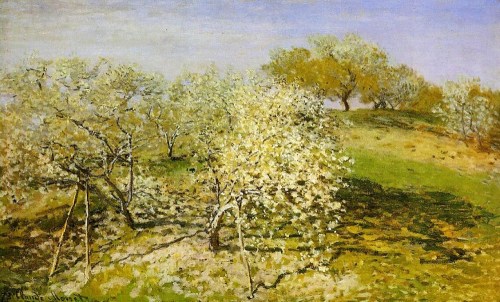
Apple Trees in Bloom by Claude Monet

(The painting is Apple Trees in Bloom by Claude Monet.)

Posted in Uncategorized | 6 Comments

The Ghost

The Ghost
by Theodora Goss

At night, when the others are all
asleep in their beds,
dreaming the incoherent
dreams of the night,
I sit in this room, alone
by the light of the lamp,
and I write.

Are my dreams as incoherent
as theirs, though I sit
awake? Sometimes I think so,
and feel so alone.
There is nothing like the night
to do that — the night
and the moon.

And then sometimes it winks
through the window, I think,
and suddenly I feel
comforted and at ease,
as though the chairs were my friends,
and the windows, and even
the trees.

And I think — philosophical, since
it is night, and the others
are all where they ought to be,
asleep in their beds —
that being a writer is rather
like being a ghost,
which needs

only the night and the lonely
light of the lamp,
and the friendly chairs — in short,
to haunt a room
where incomprehensible dreams
can cohere and
take form.

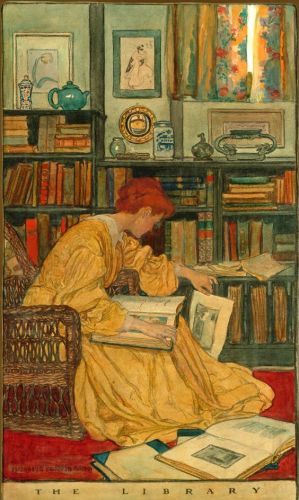
The Library by Elizabeth Shippen Green

(The image is The Library by Elizabeth Shippen Green.)

Posted in Uncategorized | Leave a comment

Goldilocks and the Bear

Goldilocks and the Bear
by Theodora Goss

They met when they were children.

She was a thief,
yellow-haired, small for her age,
only twelve years old, already hardened
by poverty, already a noted pickpocket,
stealing into the bears’ house.

He was a rube, a rustic,
or so she said then. A mark
is what she called him —
to his face, no less.

He was the one who found her in his bedroom,
trying to climb out the window,
and hid her in his closet
while his father raged:
who had stolen the carved wooden box
filled with gold coins, the profits
of their honey business?

He would not let her keep the coins.
He was not that much of a rube.

But while his father was talking to the constable,
a comical fellow straight out of Shakespeare,
he returned the box, saying he had found it
by the kitchen door, where the thief must have dropped it
on his way out. They should look in the forest —
he could be a mile away by now.

That night, he told her the coast was clear
and let her out the window.
At the last moment, before she made her escape,
she kissed him on the cheek
and laughed. That’s the way she was
back then, fearless.

He got on with his life,
finishing school, then going into the business,
learning how to care for the bees,
how to keep them healthy,
taking extension classes on bee diseases:
mites and spores that endanger bees directly,
hive beetles that infect their homes,
wax moths that feed on honeycombs,
damaging the larvae.
He learned what to plant in the fields,
how to prune the trees in the orchard:
to produce lavender honey, and clover,
and linden-flower.

He learned how to mold the wax sculptures
sold in the gift shop.
His mother was particularly good at those.

Meanwhile, she worked with a gang
of child thieves out of a Dickens novel:
ragged clothes, solidarity pacts,
the possibility of incarceration.
She ended up in jail once, was broken out,
continued to steal until she was fifteen
and their leader suggested prostitution.
It was, he said, an honorable profession,
as old as thieving. And she such a pretty girl,
with that yellow hair: she was sure to do well.
He would, of course, take a small percentage.
The suggestion was punctuated
by his fist on the table, and a grin
she did not like the look of.

That night she climbed up to the bear’s window —
she had not forgotten the location —
and knocked on the pane.
“Help me,” she said when he opened it.
“I need help, and you’re the only one
who’s helped me before.”

He listened patiently, then angrily:
three years’ worth of exploits
and exploitation. She showed him her wrist
where the gang leader had once broken it.
She was still small and pale from malnutrition.

They dyed her hair brown with walnuts.
He got her a job in the honey business,
first in the gift shop, then because she showed interest,
taking care of the bees.

She had never seen anything so fascinating:
like a city of soft, furry bodies
moving in a mass, then in individual flight,
seemingly wild, erratic, but purposeful.
She loved to watch them among the lavender,
the dusting of yellow pollen on their fur.
There was something purely joyful about them,
and they were always making, making —
thieves, like her, taking the nectar,
but making wax catacombs, the golden honey
more precious, she thought, than coins.

He showed her how to work among the bees,
wearing thick cotton and a hat veiled with musin,
which he did not need, protected by his pelt.
Eventually, he asked her to dinner
with his parents.

His mother said she was charming.
His father had a serious talk
with him: you can’t trust humans, he said.
They’re not like bears. Think of that thief, long ago,
who tried to take our gold.
They don’t even sleep in winter,
which is unnatural, unbearlike.
If you have to fall for someone, can’t it be
another bear from a good family,
like ours?

The bear explained that love
doesn’t work like that.

When he asked her to marry him
beneath the linden branches,
she said, aren’t you afraid
I might still be that girl?
That I might become a thief again?
You are, and you might, he said.
But I’m not my father. I’ve always been willing
to take risks, like letting you go that day
or trying new honey flavors. Look how well
the rhubarb honey turned out.

I’m not rhubarb honey, she said, laughing.
Close enough, he said, and kissed her.

Goldilocks and the bear lived to a grand old age
together. Their children could turn
into bears at will. One married a princess,
one joined the circus,
one took over the honey business.
They have five grandchildren.
Her hair is silver now.

Look how well her thievery turned out.
She got the gold, she got the bear,
she got the fields of clover,
the flowering orchard, the house filled with sunlight
and sweetness, like a jar of honey. The life
of a happy woman.
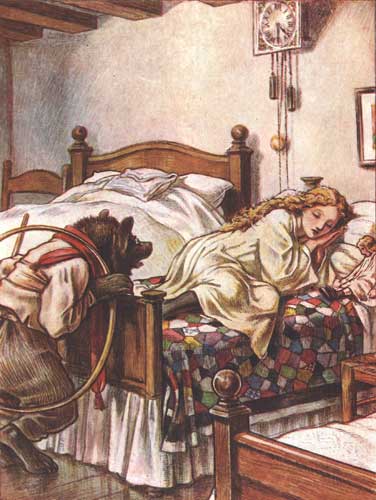
Goldilocks and the Bear by Paul Woodroffe

(The illustration is by Paul Woodroffe.)

Posted in Uncategorized | 12 Comments