The Changeling

The Changeling
by Theodora Goss

What do you do? He wore his leather jacket to school,
pulled the fire alarm, felt up one of the nuns.
Detention was a time to draw rocket ships
or race cars. He liked things that go fast (skateboards),
things that were secret (cellars), things that squealed
(mice mostly, but also hamsters). He never harmed them
but put them in desks, purses, girls’ hair.
He read books on poisonous mushrooms and making bombs.

What do you do? Tell him, you are a doll,
created from sticks and feathers? Go back where
you came from? He would grin, get your daughter pregnant,
set your barn on fire.

Puck by Sir Joshua Reynolds

(The painting is Puck by Sir Joshua Reynolds. This poem was published in my collection Songs for Ophelia.)

Posted in Uncategorized | Leave a comment

Beauty to the Beast

Beauty to the Beast
by Theodora Goss

When I dare walk in fields, barefoot and tender,
trace thorns with my finger, swallow amber,
crawl into the badger’s chamber, comb
lightning’s loose hair in a crashing storm,
walk in a wolf’s eye, lie
naked on granite, ignore the curse
on the castle door, drive a tooth into the boar’s hide,
ride adders, tangle the horned horse,
when I dare watch the east
with unprotected eyes, then I dare love you, Beast.

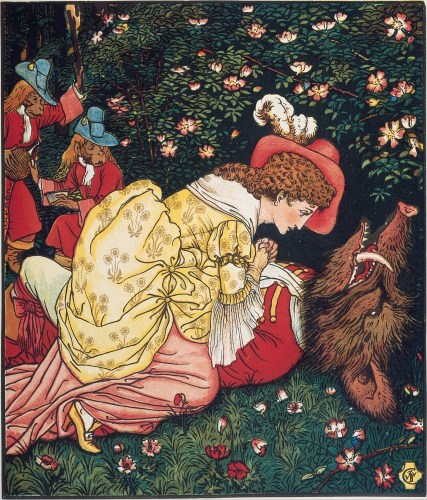
Beauty and the Beast 2 by Walter Crane

(The image is an illustration for “Beauty and the Beast” by Walter Crane.)

Posted in Uncategorized | 2 Comments

Philomela

Philomela
by Theodora Goss

Where did Philomela, raped and mute,
find the threads to weave a tapestry,
imprisoned as she was in a tower,
in the forest of Thrace,
you ask me.

And I answer, the trees
bent their branches to give her
green leaves, from which she pulled
filaments. The birds flying above let fall
red and brown and orange feathers,
which she spun into strong fibers.
Blue came from the sky reflected in a pool,
wound on a spool by her clever fingers.
Clouds descended so she could have white
like tufts of wool. For black,
thin strands of darkness without stars
were donated by night, and the day
would have given all her yellow away
if Philomela had asked.
The moon contributed a skein
of her own silver hair, and purple twilight
wove itself into the tapestry
to set Philomela free
from her prison, her silence.
You could say they collaborated
to tell her story.

When the tapestry had been woven,
thread by thread, night said:
she has been silenced, this young
woman, Procne’s sister. But together
we have given her a tongue.

The Spinner by William-Adolphe Bouguereau

(The painting is The Spinner by William-Adolphe Bouguereau.)

Posted in Uncategorized | Leave a comment

As I Was Walking

As I Was Walking
by Theodora Goss

I met, as I was walking,
nature, my mother’s mother,
beside the cold gray waters
of an undulating sea,

like granite filled with motion,
like silk the hue of gravel,
whose veins of quartz or borders
of lace broke endlessly.

She stared at the horizon
where nothing moved or altered,
while over us a cold wind
rearranged the clouds

that looked like chunks of boulder
hewn in some gray quarry.
A premature white moon slipped
through their scattered crowds.

“Lady,” I said, staring
at the far horizon,
wondering why she stood there,
“I have loved you long.

“My mother told me stories
of your wild procession,
and when a child she sang me
sleeping with your song.”

She neither moved nor answered
for an extended moment.
At last she turned and faced me.
I saw her blank gray eyes,

blind, with a film across them,
like foam upon the shingle.
They could not fix me, scanning
instead the darkened skies.

“Welcome, my daughter’s daughter,”
she said with a voice like pebbles
rattling down the slopes
of a long-abandoned mine.

“Recall your mother’s stories
of when I danced through forests
with ivy-covered maenads,
drinking golden wine,

“Recall the clashing cymbals,
and still the wild procession
will live within that memory.
But I can stir no more,

“and the only song remaining
is the sound of billows
desolately breaking
on this barren shore.”

The moon slipped through the heavens
as we stood together,
watching the horizon
like an empty rune.

Then I took her hands
and danced upon the shingle,
and she sang, like pebbles cracking,
the old, old tune.

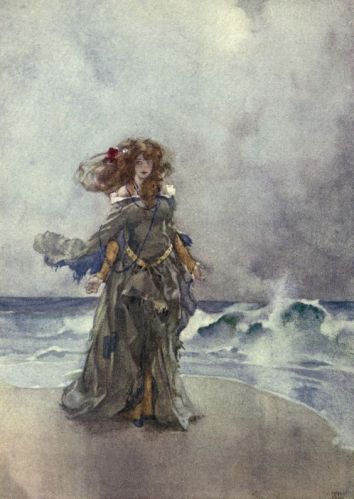
Illustration by William Russell Flint

(The illustration is by William Russell Flint. This poem was published in my collection Songs for Ophelia.)

Posted in Uncategorized | Leave a comment

The Sorceress in the Tower

The Sorceress in the Tower
by Theodora Goss

You’re speaking to me, and you don’t know, you can’t see,
that I’m very far away. Deep in the forest
there is a tower surrounded by a high wall,
and in that tower lives a sorceress. That’s who I am.

Within that tower hang tapestries with scenes
of a hunt in which the unicorn spears the hunter,
who has been betrayed by the maiden he was trusting
to catch the magical beast, his intended quarry.
The walls in the library are lined with bookshelves
of rich old oak, filled with books in leather bindings,
some handwritten, some printed, with the titles
stamped in gilt on their spines.

At the top of the tower there is a room with windows
that look out over the surrounding countryside.
Under one is a desk, with a pen and inkwell
that never runs dry. That’s where she sits and writes
her spells, and also general correspondence.
The room contains a bed shaped like a swan,
a wardrobe filled with the sorts of dresses a sorceress
would wear, whether she wants to go to a ball
and cast a curse on the prince, or attend a convention
of sorceresses (they meet semi-annually),
or sit at home on Sunday, randomly
doing magic. On one of her bedroom walls hangs a mirror
that will reveal any scene in the past or present
if asked politely (there is an etiquette
in talking to magic mirrors. They’re most particular.)

Downstairs are the library filled with books
and a kitchen in which she often eats her breakfast.
It contains an oven that can bake anything
from brownies to an elaborate chocolate cake,
a kettle that is perpetually filled with soup,
French onion, cream of mushroom, tomato bisque,
an icebox that never melts and is never empty,
a pantry that’s always stocked. In the kitchen closet
hang a broom that sweeps, a dustpan that carries dust
to the compost heap. Everything runs on magic.
The skillet fries up eggs, and after lunch,
the dishes wash themselves.

Outside the tower, within the surrounding wall,
there is an orchard of fruit trees: apples, pears,
peaches, even cherries and apricots
if the frost doesn’t get them, as well as raspberry bushes.
By the kitchen door, an herb garden grows in knots,
both ornamental and fragrant. Vegetables
flourish in rows: tomatoes, aubergines,
cabbages, peas, the various kinds of squash.
In June, the rose arbor will be a riot
of albas and gallicas, damasks and mosses.
On summer mornings, she likes to clip the roses
and bring them inside, put a vase on the library table
so the entire tower is filled with their perfume,
from the kitchen to her bedroom.

The sorceress lives in that tower alone, except
for a cat — who owns whom has not been determined.
They argue, mostly about philosophical subjects.
And an owl who lives in the attic. And the toad
at the bottom of the garden. Sometimes Grimalkin
(the cat) tells her she needs to get out more often,
but sorceresses are generally introverts.
Anyway, she has plenty of company:
the maiden in the tapestry likes to talk,
as does the mirror, when it’s in the mood,
and she has her library. Of course the trees
converse with her as she walks through the forest.
The birds call down to ask how she is doing
and the winds greet her by name. So maybe alone
isn’t quite the right word.

“Can you pass the salt?” you ask, and I look up, startled,
because it’s such a long way back from my tower
to this table, so far to return. Fortunately,
the sorceress also owns a pair of shoes
that can carry her anywhere in an instant. Now,
what were you saying?

Illustration by Charles Robinson

(The illustration is by Charles Robinson.)

Posted in Uncategorized | Leave a comment

Swan Girls

Swan Girls
by Theodora Goss

They are so lovely, the wild swan girls:
white wings and absence . . .

1. How to recognize a swan girl.

She will have delicate wrists.
You will be able to circle her wrists
with your hands. No, don’t try it:
you don’t hold swan girls, not like that.
Any suggestion of captivity sends them flying
off on white swan wings, or on high heels
across a street or continent.

They can’t bear to be caught.

No, look at her wrists: skin over bone, with faint
pinpricks where the pinions go.

2. How to catch a swan girl.

Feign lack of interest.
Stare off into the distance, at a tree perhaps
or a beach, or the New York skyline.
Turn to her. Be polite, almost too polite.
Ask a question to which she doesn’t know the answer.
(Will it snow tomorrow? What are clouds make of?
How do you say eternity in Norwegian?)

Interest her, and keep her interested,
or she will fly off.

3. How to keep a swan girl.

You can’t, not in a house or an apartment,
not in a city, sometimes not even a country.
When she telephones, you will ask, where are you?
When she laughs, it will sound
so far away, and in the background
you will hear waves, or a language you don’t understand.

4. How to marry a swan girl.

Steal her coat of feathers.
This part always goes badly.

5. How to lose a swan girl.

Wait. Eventually, she will go somewhere else.
If you hide her coat of feathers, she will leave without it.
Wait, you say, but I thought . . . Oh, those old stories?
You didn’t believe those, did you?

She knows where to get another, and anyway
she doesn’t need wings to fly.

6. How to mourn a swan girl.

Make a shrine, perhaps on a dresser or small table.
Three swan feathers, a candle, a stone smoothed
by ocean waves. That should do it.

Sit on the sofa. Hold one of the feathers. Cry.
Realize it was inevitable.
Swan girls fly. It’s just what they do.
It wasn’t you.

7. How to be a swan girl.

There are no rules the sky is infinite
the world is yours laid out in rivers and mountains
like a great quilt pieced by your grandmother.

She is older than they are.

Her hair is white as snow and covers them
her eyes are bright as stars and when she laughs
avalanches.

You take after her.

Swan girl where will you go?
Everywhere you say and then
everywhere else.

The Wild Swans by Helen Stratton

(The image is The Wild Swans by Helen Stratton.)

Posted in Uncategorized | 5 Comments

The Red Shoes

The Red Shoes
by Theodora Goss

There are days
when I too want to cut off my feet.

Days on which I desire too much, on which I am filled
with longing for what I don’t have, and may never.
When I feel that black hole in my chest
(like a manhole missing its cover)
into which things fall: my phone, the alarm clock,
the bulletin board on the wall,
the to-do list on my desk,
all my best intentions, and I think,
who needs feet? Especially
feet in red shoes.

Once you put the red shoes on,
you can never take them off.
I put them on when I was fifteen
and first fell in love,
and first wanted to live
anywhere but where I was living.

I thought, Let me be wild. Let me dance, just a little.
The red shoes never take you anywhere sensible.
They will take you to Paris
when your credit card is maxed out.

That, of course, is when I first wanted to become
a writer. One of the incorrigible.

But sometimes you get tired
of dancing everywhere: down the street,
on the subway.

And you think, I could just take a hatchet to them.
Karen did it, and she’s up in heaven
somewhere, where good girls go.
She no longer wants anything.
She stopped writing long ago.

But what about Hans? Because he had a pair as well.
I suspect he’s tap-dancing
in the hell writers make for themselves,
red shoes flashing (his had spangles).
He could never give up desire,
no matter how hard he tried.
He was ugly, and therefore wanted everything.
(As we are all ugly, if not outside, then inside,
all ducklings who only occasionally
recognize our swan parentage.)
He tried very hard to be good,
but kept falling in love,
which is a disadvantage.

So here I am, red shoes on (they never come off):
sometimes they are sandals, sometimes rain boots.
And I don’t know what to do with them except keep walking,
which is also dancing, because although I may tire,
they don’t.

She Danced Through the Dark Wood by Katherine Cameron

(The illustration is She Danced Through the Dark Wood by Katherine Cameron.)

Posted in Uncategorized | Leave a comment