The Crabs

The Crabs
by Theodora Goss

Under the water
the crabs, in their camouflage,
crawl sideways suddenly,
silently, startlingly,
over the ocean floor,
segmented, carapaced,
each individually
dancing its mute ballet,
like a clawed metaphor.

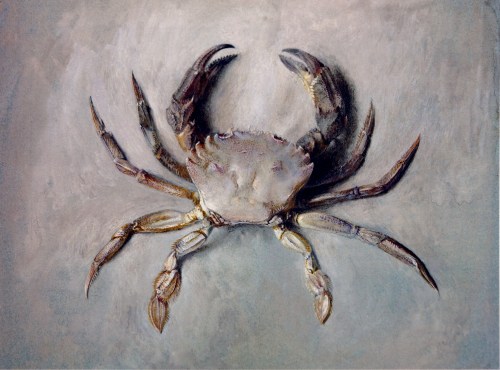
Velvet Crab by John Ruskin

(The painting is Velvet Crab by John Ruskin)

Posted in Uncategorized | Leave a comment

The Ruined Cathedral

The Ruined Cathedral
by Theodora Goss

Gray monks have wandered here, chanting their canticles,
great kings have walked beneath these archways of wrought stone,
and holy ladies read windows of parables,
and late into the night, possessing all alone
the rose-shaped turrets, bats have dived and shrieked and spun.

The monks are laid to rest beneath the graveyard grass,
the kings beneath grand slabs, the ladies in fine tombs,
and dust and sunlight now are all that shift or pass,
except that little bats still wheel across the rooms,
the final visitants that come, or are to come.

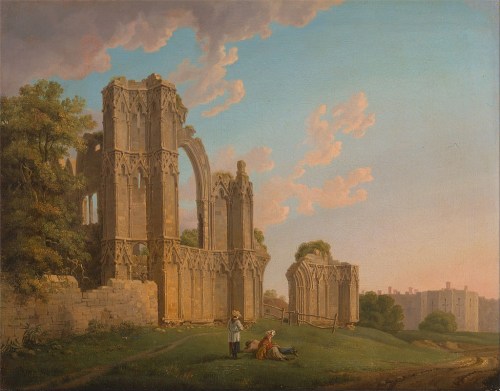
St. Mary's Abbey, York by Michael Angelo Rooker

(The image is St. Mary’s Abbey, York by Michael Angelo Rooker. The poem is from my collection Songs for Ophelia.)

Posted in Uncategorized | Leave a comment

Tiredness

Tiredness
by Theodora Goss

Tiredness has its own beauty.
It is late, so late, and I have at last
done my duty, fulfilled
whatever needed fulfilling, completed
the tasks of the day. Now, at last, darkness
can come, and I can wrap myself in it,
as though in a warm blanket.

Now, at last, I can sleep
on comfortable pillows, between
cool sheets, well-worn, freshly-laundered,
knowing I am free to enter
that other country, its dark shore
separated from this one only
by the river of forgetting.

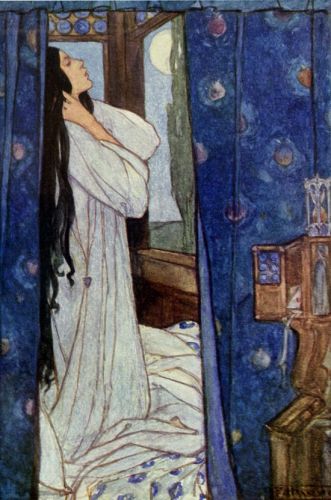
Illustration by Emma Florence Harrison

(The illustration is by Emma Florence Harrison.)

Posted in Uncategorized | Leave a comment

Tam Lin Remembers the Fairy Queen

Tam Lin Remembers the Fairy Queen
by Theodora Goss

She had eyes like apple seeds.

A small, angular face that reminded me
of a fox’s mask. Was it a mask she wore
the whole time I was with her?

The thing about fairies is, they’re not like us,
material. Indeed, they most resemble
assemblages constructed from our dreams.
Their visible forms are for our benefit.

Sometimes, as we lay together in bed
under a canopy of spider silk,
I would turn and find she had become a tree,
branches for arms, a bird’s nest between her legs,
with three blue, speckled eggs. Were they our children?
I’d blink, and she would be a woman again,
yawning and stretching as human women do.
She’d smile at me with a fox’s sly, wise smile
as though she had tricked me.

The castle was sometimes made of rough gray stone
covered with moss, sometimes of murky water
with fish swimming in the walls. When we danced, the music
came from viols or the buzz of a hundred bees.
I sat on chairs that were either toadstools or clouds,
and ate from plates that stared back up at me,
blinking iridescent eyes. What did I eat there?
Air? Insects? Salads of delicate herbs?
The bread tasted like ashes.

Sometimes she loved me, and we would ride together
on robins, or was it flowering hawthorn branches
whose thorns would prick my legs through leather trousers?
With her strange retinue: the fairy knights
riding on weasels, the goblin standard-bearers
holding thistle spears. They were always half something else,
with the heads of toads or owls, a bat’s black wings.
Everything there was always half something else,
except the fairy women, wholly themselves,
and so luminous you had to look at them
through tinted spectacles. It was the fashion
to sew living butterflies to their shoulders,
so they moved in a halo of colored dust
and panicked flapping.
Awkwardly, at the rear of the procession,
walked a stray cat she had turned into a boy,
who mewed and tried to scratch me.

I was mostly unhappy, but sometimes happy. The problem
is this: I would rather be unhappy in fairyland
than happy elsewhere.

At night, I lie beside a woman who never
turns into a tree, who bears me human children.
And all I can think of is her hard black eyes,
which sometimes looked at me with such disdain,
her small red mouth that never told me the truth
and laughed when I believed her.
That fox’s face, which was probably always a mask.

Sometimes I go into the forest alone
and whisper into the hollow knot of an oak:
I’d rather spend an hour in fairyland
than a lifetime elsewhere.
Then I stand in the green silence, with only the cries
of birds, the shush of the oak leaves high above,
and wonder if she’s listening.

In Fairyland by Charles Rennie Mackintosh

(The illustration is In Fairyland by Charles Rennie Mackintosh.)

Posted in Uncategorized | 11 Comments

Green Man

Green Man
by Theodora Goss

Come to me out of the forest, man of leaves,
whose arms are branches, whose legs are twin trunks,
rough bark covered with lichen. Come and take
my hands in yours, and lead me in this dance:

In spring, green buds will sprout upon your head;
in summer they will lengthen into leaves.
Oak man, willow man, linden man, which are you?
In autumn, they will fall, and through the winter
you will be bare, with only clumps of snow
or birds upon your branches.

Come and love me,
my man of leaves, my forest man. For you,
I’ll be an alder woman, birch woman.
In spring I’ll wear pink blossoms like the cherry;
in summer ripening fruit will bend my boughs;
in autumn I will bear, distributing
a hundred seeds, our children. And the birds
will sing my praises. Let us learn to love
the sun and wind together; let us twine
our bodies, filled with sap, until we make
a single tree on which two different kinds
of leaves are growing, where birds build their nests,
among whose roots the squirrels hide their nuts,
storing them for winter.

A hundred years from now, we will still stand,
crooked perhaps, the sap running more slowly,
our two hearts beating, separately and together,
under the summer skies, in autumn rains.

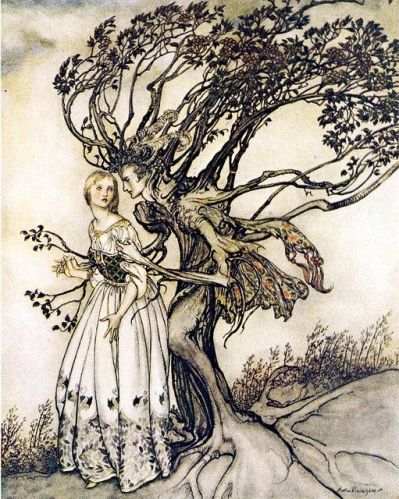
Illustration by Arthur Rackham

(The illustration is by Arthur Rackham.)

Posted in Uncategorized | 2 Comments

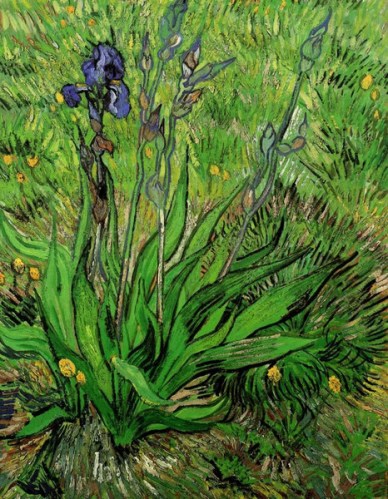
The Purple Iris

The Purple Iris
by Theodora Goss

There was one purple iris in a bed
where many would be blooming in two weeks,
and I thought, what made you come out so early?
Did you hear birds and think, it’s summer now,
time to get started? But it’s only May.
You should have waited until June, when all
your brothers would be blooming, purple, lilac,
yellow — heraldic, looking very French.
Or was it an interior impulse, rather
than something external to yourself? Whatever
there is in irises of soul or mind
telling you — now. Now is the time to open.

I suppose we all have something in us like that,
a sense, an intuition, telling us
now. Open yourself to wind and weather,
put on your purple velvet fringed with yellow,
fulfill your purpose, whether late or early,
even if it’s only May and winter’s chill
still lingers, though the garden is filled with birdsong.
Even if you’re the only iris blooming
in that particular bed.

The Iris by Vincent Van Gogh

(The painting is The Iris by Vincent Van Gogh.)

Posted in Uncategorized | 3 Comments

One of Those Days

One of Those Days
by Theodora Goss

It is one of those days when I feel completely out of step
with the world, when I am convinced
I should be somewhere different . . .

Walking through a forest of tall trees, preferably maples
because it is autumn, and their leaves would create
a carpet, maybe even a path
of red and yellow. And I could follow it,
in the belief that I was going somewhere.

What has happened to my life?

My moments are measured by clocks,
not by the chirping of crickets, or the call
of birds in the underbrush at the edge of the forest,
not by the movements of water
as it falls over rocks into a pool.
Not by the sun sinking lower.
Although I know, I can feel, that it is all
falling: the leaves, the sun,
the running water into the still water.
And then the birds and crickets falling silent.

I can feel it even though in my efficient life
where the clocks are marking time,
all the minutes are the same: one after another,
in equal intervals. Still, outside my window,
behind the reflected electric lights,
slowly darkness comes,

like a benediction. And I feel
once again, that I was born elsewhere
and have, still, elsewhere to go . . .
where beneath tall trees, slowly the leaves
and evening are falling together.

Woman at a Bureau by William Smith Anderson

(The painting is Woman at a Bureau by William Smith Anderson.)

Posted in Uncategorized | 5 Comments