The Witch’s Cat

The Witch’s Cat
by Theodora Goss

A witch’s cat isn’t always black.
Mine is an elegant tortoiseshell.
She refuses to come when I call to her,
but as soon as I start reciting a spell,
she’ll appear at the top of the stairs,
as though she was never gone at all.

Where does she go when she’s not with me?
She won’t tell me, however much I ask.
Whether for pleasure or to fulfill
some secretive, inscrutable task
given to her by Mother Night.
She simply says, “You’ve made a mistake,

Mistress mine. I was always here,”
then looks at me with those yellow eyes,
like two full moons. A witch’s cat
isn’t always truthful, but she is wise.
She knows where magical plants are found
and when the midsummer sun will rise.

She knows which toads are poisonous
and how to pronounce the ancient words,
whether Latin, Greek, or Sumerian.
She understands the weather’s moods,
and knows the way to the hidden glade
where witches meet, in the heart of the woods.

There we catch up on the latest charms,
sharing ingredients and recipes,
then dance until the moon has set,
while Mother Night walks beneath the trees,
a tall, pale woman as old as time,
whose long black hair is filled with stars.

When my cat says, “Mistress, it’s time to go,”
she climbs on the back of my broom, and we fly
over the sleeping town below,
through a purple and orange sky,
back home, where I promptly get to work,
while she curls in the armchair and sleeps all day!

A witch’s cat is never good,
nor ever entirely bad. She’s herself.
Sometimes she’ll suddenly walk through walls
or appear on the highest shelf
where I hid the cream and knock it down,
more troublesome than any elf.

But what would I do without her? Who
would translate when I summon a demon,
or frighten mice from the herbs in the pantry,
or watch over my simmering cauldron?
Or keep the loneliness away,
a magic stronger than any potion?
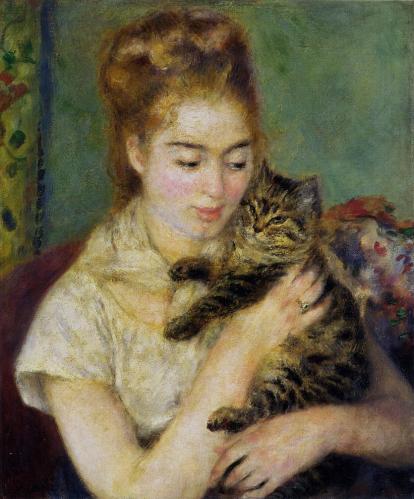
woman-with-a-cat-by-pierre-auguste-renoir

(The image is Woman with a Cat by Pierre-Auguste Renoir. The cat in the painting is a tabby, not a tortie, but I couldn’t find a painting of an actually tortoiseshell . . . even though I think they’re among the most beautiful cats!)

Posted in Uncategorized | 3 Comments

The Witch’s Warning

The Witch’s Warning
by Theodora Goss

This ground is cursed.  I would leave it,
if I were a man, as you are:
leave the moss-overgrown
stones that bound the estate,
leave the damp of the hollow,
leave the hill where a scar
reminds you that penance is needed,
even if proffered late.

You will not listen to me,
to the woman with rain in the tangles
of hair escaping her kerchief
who watches with answerless eyes.
You ride, young lord, through the shadows
of immemorial beeches:
all yours, all yours, but I’d leave them,
young lord, if you were wise.

Ride to the white mausoleum
where your ancestors wait to receive you,
ride past the marshy expanses
where frogs make ominous sounds,
ride passed the ruined hillside
without a notion of pity,
without remorse, to the manor,
satisfied with your rounds.

The tree that stood on that hillside
was older than this structure,
older than your right here
or your family’s name.
All your ancestors shivered
at the fall of that timber,
whose trunk is hewn for a pleasure-house,
whose branches roast your game.

Go to the church with the steeple
and sleep among downy pillows;
the gods that are older than boundaries
are opening up their eyes.
They meet in the damp of the hollow,
they dance on the marshy expanses
where their feet make no dint on the turf
and the air seems filled with sighs.
You would leave, young lord, you would leave here,
if you, like me, were wise.

The West Wind by Walter Crane

(The image is The West Wind by Walter Crane. This poem appeared, in a slightly different form, in my collection Songs for Ophelia.)

Posted in Uncategorized | 2 Comments

To a Friend I Have Not Seen for a Long Time

To a Friend I Have Not Seen for a Long Time
by Theodora Goss

What are the clouds doing
where you are?
Are they building castles
high in the blue dome
we call the sky?
Are they forming themselves
into landscapes?

What is the sea doing?
Has it stopped, even for a moment,
crashing into and slowly,
slowly wearing away the shore?
Is it still smoothing
shells, pebbles?

Is the yarrow blooming
in the side yard, like small
yellow buttons?

Are the sea oats on the dunes
rattling their seed pods,
as though telling the world
be quiet, there is value
in just listening?

Is the paint on the old clapboard house
wearing away? And are the pelicans
still hanging suspended
in the air, like kites
flown by invisible children?

What are you doing with your life?
Tell me all the news:
everything that has been happening
to you, and not happening,
which is, potentially,
more important.

Eleanor, 1907 by Frank Weston Benson

(The image is Eleanor, 1907 by Frank Weston Benson.)

Posted in Uncategorized | Leave a comment

The Crabs

The Crabs
by Theodora Goss

Under the water
the crabs, in their camouflage,
crawl sideways suddenly,
silently, startlingly,
over the ocean floor,
segmented, carapaced,
each individually
dancing its mute ballet,
like a clawed metaphor.

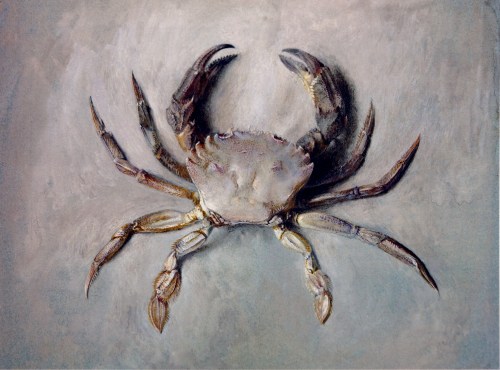
Velvet Crab by John Ruskin

(The painting is Velvet Crab by John Ruskin)

Posted in Uncategorized | Leave a comment

The Ruined Cathedral

The Ruined Cathedral
by Theodora Goss

Gray monks have wandered here, chanting their canticles,
great kings have walked beneath these archways of wrought stone,
and holy ladies read windows of parables,
and late into the night, possessing all alone
the rose-shaped turrets, bats have dived and shrieked and spun.

The monks are laid to rest beneath the graveyard grass,
the kings beneath grand slabs, the ladies in fine tombs,
and dust and sunlight now are all that shift or pass,
except that little bats still wheel across the rooms,
the final visitants that come, or are to come.

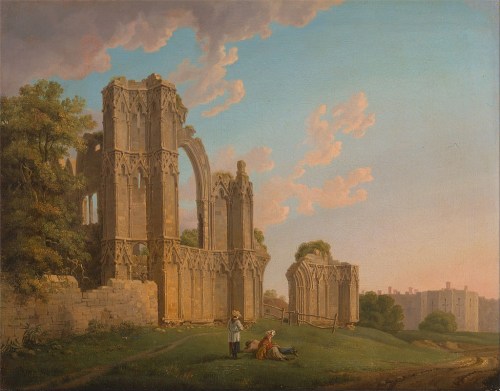
St. Mary's Abbey, York by Michael Angelo Rooker

(The image is St. Mary’s Abbey, York by Michael Angelo Rooker. The poem is from my collection Songs for Ophelia.)

Posted in Uncategorized | Leave a comment

Tiredness

Tiredness
by Theodora Goss

Tiredness has its own beauty.
It is late, so late, and I have at last
done my duty, fulfilled
whatever needed fulfilling, completed
the tasks of the day. Now, at last, darkness
can come, and I can wrap myself in it,
as though in a warm blanket.

Now, at last, I can sleep
on comfortable pillows, between
cool sheets, well-worn, freshly-laundered,
knowing I am free to enter
that other country, its dark shore
separated from this one only
by the river of forgetting.

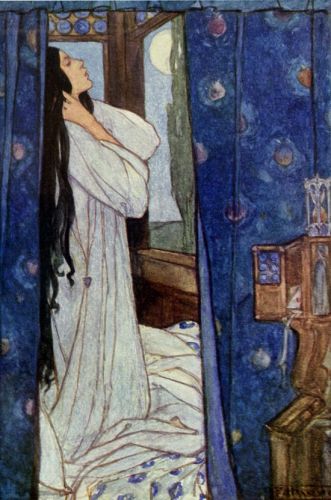
Illustration by Emma Florence Harrison

(The illustration is by Emma Florence Harrison.)

Posted in Uncategorized | Leave a comment

Tam Lin Remembers the Fairy Queen

Tam Lin Remembers the Fairy Queen
by Theodora Goss

She had eyes like apple seeds.

A small, angular face that reminded me
of a fox’s mask. Was it a mask she wore
the whole time I was with her?

The thing about fairies is, they’re not like us,
material. Indeed, they most resemble
assemblages constructed from our dreams.
Their visible forms are for our benefit.

Sometimes, as we lay together in bed
under a canopy of spider silk,
I would turn and find she had become a tree,
branches for arms, a bird’s nest between her legs,
with three blue, speckled eggs. Were they our children?
I’d blink, and she would be a woman again,
yawning and stretching as human women do.
She’d smile at me with a fox’s sly, wise smile
as though she had tricked me.

The castle was sometimes made of rough gray stone
covered with moss, sometimes of murky water
with fish swimming in the walls. When we danced, the music
came from viols or the buzz of a hundred bees.
I sat on chairs that were either toadstools or clouds,
and ate from plates that stared back up at me,
blinking iridescent eyes. What did I eat there?
Air? Insects? Salads of delicate herbs?
The bread tasted like ashes.

Sometimes she loved me, and we would ride together
on robins, or was it flowering hawthorn branches
whose thorns would prick my legs through leather trousers?
With her strange retinue: the fairy knights
riding on weasels, the goblin standard-bearers
holding thistle spears. They were always half something else,
with the heads of toads or owls, a bat’s black wings.
Everything there was always half something else,
except the fairy women, wholly themselves,
and so luminous you had to look at them
through tinted spectacles. It was the fashion
to sew living butterflies to their shoulders,
so they moved in a halo of colored dust
and panicked flapping.
Awkwardly, at the rear of the procession,
walked a stray cat she had turned into a boy,
who mewed and tried to scratch me.

I was mostly unhappy, but sometimes happy. The problem
is this: I would rather be unhappy in fairyland
than happy elsewhere.

At night, I lie beside a woman who never
turns into a tree, who bears me human children.
And all I can think of is her hard black eyes,
which sometimes looked at me with such disdain,
her small red mouth that never told me the truth
and laughed when I believed her.
That fox’s face, which was probably always a mask.

Sometimes I go into the forest alone
and whisper into the hollow knot of an oak:
I’d rather spend an hour in fairyland
than a lifetime elsewhere.
Then I stand in the green silence, with only the cries
of birds, the shush of the oak leaves high above,
and wonder if she’s listening.

In Fairyland by Charles Rennie Mackintosh

(The illustration is In Fairyland by Charles Rennie Mackintosh.)

Posted in Uncategorized | 11 Comments