The Gold-Spinner

The Gold-Spinner
by Theodora Goss

There was a little man, I told him.

I gave the little man my rosary,
I gave the little man my ring,
my mother’s ring, which she had given me
as she lay dying. A thin circlet of gold
with a garnet, fit for a commoner.

As I was a commoner, I reminded him.
Nothing magical about me.

Very well, he said. You may go
back to your father’s mill. I have no use
for a miller’s daughter without magic in her fingers.
I’ll keep the three roomfuls of gold.

I walked away from the palace, still barefoot,
still dressed in rags, looking behind me
surreptitiously, afraid he would change his mind.
Afraid he would realize he’d been tricked.
I mean, what kind of name
is Rumpelstiltskin?

But he would have kept me spinning
in a succession of rooms, forever.

I passed my father’s mill without entering,
either to greet or berate. I wanted you to be queen,
he had told me, after I said how could you
betray me like this?
You deserve that, you deserve better
than your mother. What kind of life
did I give her?

No, I wasn’t going back there.

By mid-afternoon I had left the town,
I had forded the river, I had come
to unfamiliar fields. I sat me down
by a hedge on which a few late roses bloomed
and from a thorn I plucked a tuft of wool
left by a passing sheep. I spun,
twisting it between my fingers
as my mother had taught me.
She, too, had the gift.

I coiled the resulting thread
of thin, soft gold
around my wrist. Somewhere along the road
it would buy me bread.

Until then, there were crabapples
and blackberries to share with the birds.
And the road ahead of me,
leading I knew not where, but somewhere different
than the road behind.
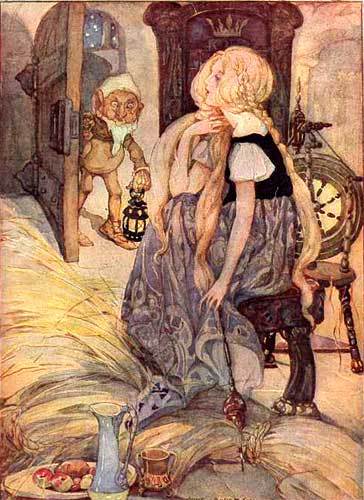
Illustration for Rumpelstiltskin by Anne Andersen

(The illustration is by Anne Andersen. Except in my poem, of course, there is no little man . . .)

Posted in Uncategorized | 5 Comments

The Stepsister’s Tale

The Stepsister’s Tale
by Theodora Goss

It isn’t easy, cutting into your feet.

Years later, when I had become a podiatrist,
I learned the parts of the feet. Did you know your feet
contain a quarter of your bones? Calcaneus, talus, cuboid, navicular.
Lateral, intermediate, and medial cuneiform.
Metatarsals and then the phalanges, proximal, middle, distal.
They’re beautiful on the tongue, these words from a foreign language.

My sister cut into her heels, which are in the hindfoot.
I cut into my big toes, called the halluces.
She cut into flesh and tendon and sinew.
I cut into bone, between the phalanges,
through the interphalangeal joint.
That’s in the forefoot, which bears half the body’s weight.
To this day, both of us walk with a slight limp.

The problem is you do desperate things for love.
We loved her, the woman who wanted us to be perfect:
unblemished skin, waist like a corsetier’s dream,
feet that would fit even the tiniest slipper.
And so we played the aristocratic game
of identify-the-princess.

Sometimes it’s a slipper, sometimes a ring.
Oh mother, love me without asking me to scrape
my fingers like carrots, cut off my heels and toes.
Eventually, she became your favorite daughter,
the cinder-girl, the princess-designate.
She was the best at being perfect, but abuse
will do that to you.

A woman comes into my office, asking me
to cut off her little toes so she can wear
the latest fashion. I sit her down and say
did you know your feet provide the body
with balance, mobility, support?
Come, let me show you a model: here’s the toe,
metatarsal and phalanges. You can see
how elegantly they move, as in a waltz,
surrounded by your blood vessels and nerves,
the ball gown of your soft tissue,
a protective coat of skin, the delicate nail.

Look, underneath, how beautiful you are . . .

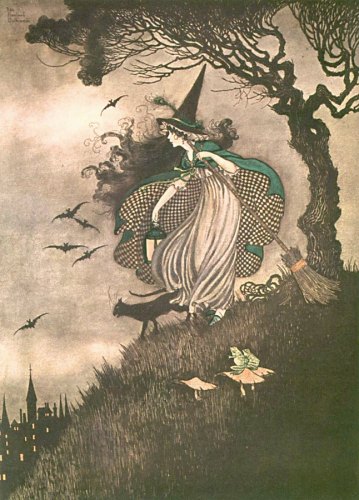
Illustration for Cinderella by Charles Folkard

(This illustration is by Charles Folkard, for an edition of Grimms’ fairy tales.)

Posted in Uncategorized | Leave a comment

The Witch-Girls

The Witch-Girls
by Theodora Goss

The witch-girls go to school just down the street.
I see them pass each morning with their brooms
and uniforms: black dresses, peaked black hats.
They giggle just like ordinary girls,
except that as they walk, their brindled cats
twine around their ankles. One will stop
and say, “You’ll trip me, Malkin,” scoldingly.
Then Malkin will look up and answer back,
“Carry me then.” The witch-girl will bend down,
scooping the cat into her arms, and perch
him on her shoulder. So the witch-girls pass.

I wish I could be one of them. Alas,
I don’t know how to fly on windy nights
or talk to bats, or brew a magic potion.
Although I think I could be good at witching.
I’d learn to curse and never comb my hair.
I’m pretty good at scaring passers-by
by making goblin faces through the window.
I’d trade white cotton dresses for black wool,
no matter how it itched. I’d fly my broom
up to the witches’ garden on the moon
where they dance nightly, kicking up their heels
with sylphs and fauns and ghouls. At least I think
that’s what they do. I don’t think witches go
to bed at nine, or even make their beds
each morning. No. Instead, they marry toads,
or live alone and read old books. They paint
landscapes in Germany, or climb the Alps,
or sit in Paris cafés eating chocolate
for lunch and maybe dinner. They get drunk
on elderberry cordial, speak with bears
on earnest topics like philology.
I wonder what the witch-girls learn in school?
Geometry that helps them walk through walls,
and how to turn a poem into a spell . . .

I wish that I could go to school with them.
I’d giggle and be wicked too, if they
would only let me.

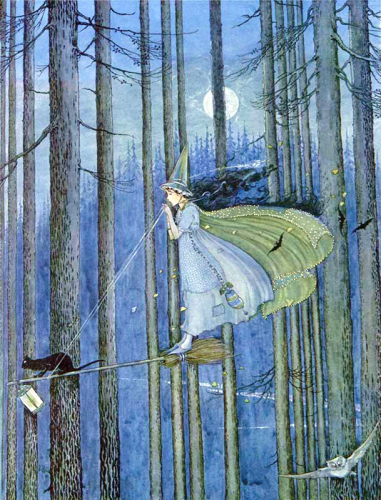
(This image is The Little Witch by Ida Rentoul Outhwaite.)

Posted in Uncategorized | Leave a comment

Why You Might Be a Witch

Why You Might Be a Witch
by Theodora Goss

Because sometimes you dream of flying
the way you used to.

Because the traffic light always changes for you.

Because when you throw the crusts of your sandwich
to sparrows in the public park, they hop close
and closer, until they perch on your finger
and look at you sideways.

Because as you walk down the street,
the wind plays with the hem of your skirt
so it swings dramatically around your ankles.

Because as you walk, determined and sensible,
your shadow is dancing.

Because a lot of people talk to cats
but for you they answer.

Because the sweetgum trees along the sidewalk
love to show you their leaves, sometimes even tossing
them in front of you, yellow veined red,
brown shot with green and yellow,
like children showing off artwork.

Because when you look up,
the moon is always smiling.

Because sometimes darkness closes around you
and you remind yourself that it’s all right,
you’ve worn this cloak before.

Because in winter you acknowledge
that snow is a blanket as well as a shroud,
and we must all sleep sometimes.

Because in spring you can hear the tinkling bell-sounds
that crocuses make, and the deeper gongs of the tulips.

Because the river waves to you in passing,
and you wave back.

Because even the brownstones of this ancient city
look at you with concern: they want to make sure you’re well.
You belong to them as much as they to you.

Because witches know what they are
and if I asked, do you remember?
You would have to confess that yes,
you do.

Witch by Ida Rentoul Outhwaite

(The illustration is by Ida Rentoul Outhwaite.)

Posted in Uncategorized | 28 Comments