The Man Reading About Munkácsy

The Man Reading About Munkácsy
by Theodora Goss

There is a man reading about Mihály Munkácsy,
the nineteenth-century Hungarian painter, sitting across from me
on the bus — the man, I mean, not Munkácsy, who died
in 1900. He is reading what looks like a biography
with illustrations called Munkácsy: Life and Works.
I think he must have dropped it in a puddle
because the front cover has that characteristic ripple
of paper that has been in contact with water.
Still, on it you can see
Munkácsy’s self-portrait, bearded, with a wild halo of hair
and resolute eyes, radiating disapproval.

If you know anything about Munkácsy, and why should you,
in this world that has so little use for artists,
you will know that he is famous primarily for his genre paintings,
like a picture of a condemned man sitting in a prison cell
having eaten his last supper, waiting only for death.
He and the candles on the table will soon be snuffed out.
Or a picture of a woman churning butter,
although he also painted society ladies
sitting in their conservatories — who doesn’t?
We should not condemn artists for such frivolity. Everyone,
except maybe art critics and philosophy professors,
likes a pretty picture of flowers.

His most famous painting is a triptych of Christ
presented to Pilate, then condemned to death by the crowd,
and finally crucified in magnificent chiaroscuro.

Toward the end of his life, with his mind destroyed by syphilis,
he painted a picture called The Victim of Flowers,
in which a woman reclining against a cushion,
one breast bare, the other half-covered by her evening gown,
is menaced by blossoms: poppies, rudbeckias, freesias.
They hover over her, the poppies’ pink mouths gaping,
the rudbeckias’ black eyes glaring, like a floral nightmare.
Some are climbing up from her groin to her torso.
And she, lying on the brown pelt of her hair,
wrapped only in luminous skin and a wisp of fabric,
is lost in ecstatic, languorous contemplation
of something outside the canvas — perhaps the artist.

At the end of his life, Munkácsy was confined
to a mental hospital near Bonn, where he finally collapsed
and died. He is buried near Budapest.
The man, who has a patch on one knee of his trousers
and frayed cuffs on his checked wool jacket, has almost finished
his book, judging from the number of pages turned,
so he must be reading about the end of Munkácsy’s life.
Slowly, under his spectacles, a tear rolls down.

Meanwhile, that fierce wild face is staring at me
from the cover with such concentration
that I feel the straps of my sundress slip from my shoulders,
baring too much flesh for public transportation.
Poppies and rudbeckias are growing from the seat around me
until they come up to my breasts. I am bathed in their perfume,
and the freesias like red trumpets are making a sound
not unlike a bus horn, but melodious.
I am blushing and furious at art and all damn artists.
Honestly if I could, I would rip that book
from the man’s gnarled hands, and slap Munkácsy’s face
good and hard — if it weren’t impolite, and also
if the scent of the poppies weren’t quite so overpowering.

(The image is The Victim of Flowers by Mihály Munkácsy.)

Posted in Uncategorized | Leave a comment

The Iris

The Iris
by Theodora Goss

All of life is trouble.
It is trouble simply to get out of bed in the morning,
to leave the safety of cool sheets, like swaddling clothes
or shrouds. Each evening,
we crawl back into the darkness we first came from
and to which we are continually returning:
the sea, the womb, the grave.

It is trouble to put on our clothes, fitting ourselves
into the general fabric of society, to find
as we look at ourselves in the badly
lit bathroom mirror, the right mindset
to face the day. To remain polite, productive,
from our pocket handkerchiefs
to our socks. We tie our shoe laces and tighten
the straps of our wrist watches.

It is trouble to walk out into the street
without being hit by a bus, without
tripping over the curb. To get through the day
without tripping over our intentions or a joke.

On the other hand, consider:
it is trouble for the iris
to push itself up through the ground,
to unfurl its purple standards, despite wind and rain,
so bees can rub themselves against the yellow fur
on its lighter sepals.

So that you, walking in the park,
with your lunch in a brown paper bag, can sit on a bench
and lose yourself in a range of blues and purples
as deep as twilight.

(The image is Irises by Claude Monet.)

Posted in Uncategorized | Leave a comment

Thoughts While Sitting on Top of a Cliff in Ireland

Thoughts While Sitting on Top of a Cliff in Ireland
by Theodora Goss

The sea below me
is furling and unfurling
like a banner. I wonder
whose banner it is, whose standard
is so blue.

There is a yellow flower
growing on the rock, with its roots
in the rock itself. Why, I wonder, has it chosen
to grow there, instead of in the soft, crumbling soil?
Does it like the challenge?

The seagulls are mewing. They are the cats
of the sky: insistent, irascible.

Above me, the clouds
are arranged in furrows. I wonder
who ploughs them.

The wind is blowing the grasses
as it blows my hair. I am both tangled
and confused. Where am I going
when I leave this island? Sometimes I wish
that like the grass, I could remain rooted.

Far below me, on the sand,
the gray seals are lying
still in the sunlight. Every once in a while,
one of them raises its head
and barks. I too sometimes feel
the need to exclaim
at the magnificence of this world.

The small stone cottages,
with their whitewash long ago washed off
by rain, their tarred felt roofs long ago
torn off by wind, huddle
into the hillside the way a leveret curls
into its mother’s belly, for warmth
and nourishment.

When this island was inhabited,
it had no church, no hospital, no shops,
no post office. Only two schools,
Catholic and Protestant. Only one of those,
supported by English coffers,
distributed free soup.

Of the people who once lived here, all that is left
are their photographs on the walls of the visitors’ center
and a video in which you can hear them speaking
through letters and diaries read
in the original Irish
with subtitles.

Soon, I will need to catch
the boat back to the mainland
and figure out my life.
Until then, all that matters
is the sunlight on my arms, and this butterfly
with its orange and brown wings
fluttering suspended,
endlessly restless in an eternal present.

It has been almost a hundred years
since anyone lived here.
I wonder if the rocks, the grasses,
the waves below, the seals, the seagulls,
miss them. I’m quite sure
the flowers, which have such short memories,
do not.

Neither will they miss me
after the air has flowed over and filled in
my absence.

(The image is Landscape in Northern Ireland by Fred Balshaw.)

Posted in Uncategorized | Leave a comment

An Important Question

An Important Question
by Theodora Goss

When she decides to drop her eyes
instead of looking back at him,
a refusal rather than a return of attention,
is she perhaps missing
the chance to change her life,
to find whatever outside herself
will correspond to her inner dialog?
That other who will answer her in the lane
at evening, beneath the linden trees,
surrounded by their scent? Is he the one
who will make the world real to her?
And if, now, this moment she does not respond,
will her self become a closed door?

Or will she be given another chance tomorrow,
and tomorrow and tomorrow? Are there
infinite chances, is the self a room
with a hundred windows, each of which looks out
into a different garden?
And will he, himself, in his specificity
be waiting for her tomorrow, just in case
she wants to hold his eyes
for an irresponsible minute?

(The image is Dora Morris by Vanessa Bell.)

Posted in Uncategorized | Leave a comment

On the Topic of Love

On the Topic of Love
by Theodora Goss

I was thinking about the topic of love, as in
what is it exactly? It’s not like the ocean,
or a tree, or a rock — these are things I understand.
Love, on the other hand,
is a cloud made of water vapor
that you can neither capture nor hold,
a butterfly’s flutter as it lands on a blossom,
the gold of a leaf before it falls and fades on the ground,
something ghostly, intangible.

But I think — correct me if I’m wrong —
that the ocean loves the shore, because it returns in waves,
motion after motion. That a tree loves the sky, because it reaches
branches and leaves upward with every movement,
and the sky in turn loves the trees as best it can,
with rain and sometimes lightning.
A butterfly loves the air, because it decorates
the currents and eddies with its purple wings — kings
are not robed more richly.
Autumn loves the leaves so much, it steals their color.
And the rocks, do they love? Is love a quality
one finds even in a pebble?
Is it that fundamental?

Perhaps gravity itself
is how the Earth loves us, holding
us close, like a mother holding the hand of her child.
When I feel that wild
longing — when I feel as though my heart has been struck
by lightning, I hold out my hand —
ghostly, vaporous, because after all we are only partly here,
haunting this world, less permanent than the rocks,
like a leaf falling from the tree, or a butterfly,
or a cloud floating against a backdrop of sky,
here for a moment and then gone.
I hold out my hand
and almost, almost manage
to touch yours.

(The image is Butterflies by Odilon Redon.)

Posted in Uncategorized | Leave a comment

Prescription

Prescription
by Theodora Goss

Take a crabapple tree
in spring, white with blossoms.
Take it in the early morning,
while all the birds in the elms
are dropping their notes on the front porch,
and the white moths are still fluttering
against the windows. While the ancient house
is dreaming its wooden dreams.
It will smell like nothing else on Earth.

Take it with a glass of water.
Swallow it down: the blossoms and their scent,
the white moths casting shadows on the floor,
the memory of the moon as she turned her pocked face
toward you the night before, the dark night
that followed. The clear light
of morning. And the crabapple tree,
even if its branches stick in your throat.
Soon, not immediately, you will begin
to feel better.

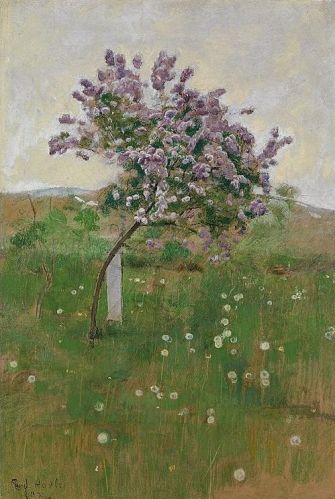
(The image is Apple Trees in Flower by Ernest Quost.)

Posted in Uncategorized | Leave a comment

Mirror, Mirror

Mirror, Mirror
by Theodora Goss

Each morning, standing barefoot on cold tiles,
I ask you, not who is the fairest in the land —
I’m neither that vain nor ambitious.

But am I as fair as I was
yesterday, or the day before yesterday,
all the yesterdays on which I was younger
than I am today. Those lines that Mother Time,
the indefatigable spider,
is spinning beneath my eyes — have they spread overnight?
Perhaps I should stop smiling so frequently.

Perhaps I should stop frowning, avoid the sun —
already it has painted a few brown spots
on my cheeks and forehead. Or sleep for a hundred years,
which is as effective, they say, as a facelift.

Each morning you say, yes, you are older now.
There are white hairs on either side of your forehead,
looking as though they had been touched by Frost,
whose fingers leave precisely such fine streaks
over the meadow grasses, the windowpanes.
Soon, you will become a winter landscape
crossed by tracks where hare and deer have passed
on their way into the darkness of the forest.
Soon, you will sprout mushrooms.

Wake up, wake up! you say.
You will sleep all too soon — now is the time
to live as though you were going to live forever,
as though winter never comes
and all the fairy tales
were true.

(The image is The Green Mirror by Guy Orlando Rose.)

Posted in Uncategorized | 4 Comments