This Poem Is About Cake

This Poem Is About Cake
by Theodora Goss

If I didn’t care
what the world thought,
I would eat all the cake.

What cake?

I don’t know, any cake.
Every cake. All the cake ever.

But no, I mean what kind of cake
specifically?

Chocolate cake, made
of equal parts flour and cocoa, frosted
with chocolate ganache, as rich
as a miser. Or angel cake, held together
by whipped egg whites and prayer, topped
with glazed strawberries. Or maybe
lemon drizzle, just sour enough
for a summer afternoon in Virginia,
or one of those Viennese tortes
named after Hapsburg princes, basically
layers of coffee cream and walnuts, studded
with history like a museum. Or maybe even
wedding cake with piped icing roses,
like a moonlit garden. Or birthday cake,
or the cake we eat at funerals, a mixture
of sugar, ginger, sad memories,
and pineapple chunks.
Or the cake my mother made
every Christmas.

I would eat it slowly,
slice by delicate slice, until I had eaten all of it.
And then I would start on the next one.

Isn’t that just a bit, I don’t know,
frivolous? You’d spend your entire life
eating cake.

Then let me start over again.
If I didn’t care what you think . . .

(The image is Strawberries and Cakes by John F. Francis.)

Posted in Uncategorized | 1 Comment

Old Hungarian Women

Old Hungarian Women
by Theodora Goss

I see them sometimes, walking
along the street, pulling
wheeled shopping baskets behind them,
or standing in the doorways
of apartment houses, talking
to one another. They wear scarves
on their heads, or hats they have knitted
themselves. They wear sensible shoes.

I see them, the old women,
and I am convinced
they are witches, every one of them.
That they know (maybe they are
the only ones who know)
what’s going on — with the weather,
the war, the political situation.
They don’t interfere — they just watch,
knowing, having seen it all before,
having lived through a war already,
through assorted revolutions,
through socialism, capitalism, all the other
isms you can think of. They have striped cats
that lie blinking on their windowsills
behind lace curtains, and flower boxes
filled with red geraniums. They make jam
from plums and syrup from elderberries.
They have magic in the tips of their fingers,
which they embroider into pillows,
doilies. They make strudel
with dough folded out of thin, flaky air,
bread rolls like clouds, paprikás
for which angels sin and fall from heaven.
They can turn into crows, gray and black,
parading around the city parks,
holding conventions.

I myself am a little scared
of the old women. I am convinced
they can see into my soul. I am not at all
sure that I have been good or clever
or polite enough to avoid their curses —
or disapproving glances, which,
to be honest, might be even worse.

Maybe someday they will let me
join them — but I would have to become
a great deal wiser, practice
how to make jam, transform myself
into a crow, the magical art
of endurance.

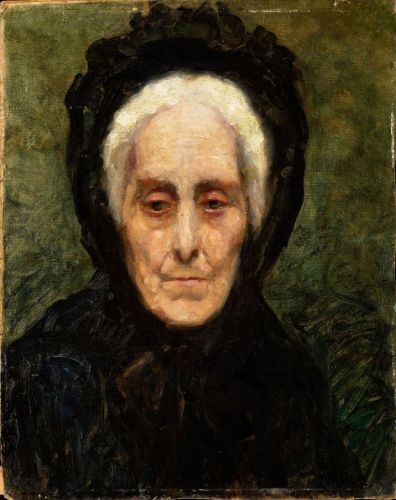
(The image is Old Woman by Sándor Bihari.)

Posted in Uncategorized | 3 Comments

Portrait of a Lady

Portrait of a Lady
by Theodora Goss

She sits on a stone bench
in the city park, under a bush
of pink roses, probably
something like Maiden’s Blush,
because they have so many
petals — you know the kind
I mean, that blossom in June
and release, if you lean in closely,
the most delicious perfume.

She is reading a book — I can’t seem
to make out the title, but certainly
some classic work of literature.
She looks the type to be reading
Tolstoy or Jane Austen, or perhaps
Agatha Christie, who knows.
Well, the roses leaning over her shoulder
that drop pink petals on the pages,
they know, of course.
And she is waiting
for someone — I can tell because
she keeps checking her watch.
I would like to think
she is waiting for someone she loves.
That would match
her general air of ease and elegance,
her essential civility.
Which is why I have called this poem
Portrait of a Lady.

Such an old-fashioned term, suitable
for a romance, or, of course, a tragedy.
Which I hope this is not —
although who knows.
Except, of course, the roses.
They know everything.
Every little thing.

They always do, damn it.

(The images is In the Rose Garden by Robert Panitzsch.)

Posted in Uncategorized | 1 Comment

The Pink Bugleweed

The Pink Bugleweed
by Theodora Goss

Such an intricate
construction, like the tower
of Babylon, reaching
to the sky, only about three
inches high, rising
from a glabrous rosette
of leaves, its flowers pink
and elegant, a ballet
dancer of a plant.

Why exactly
are you called a weed,
with your delicate bugles,
summoning the butterflies
and bees, which arrive
like courtiers, worshiping
your beauty? You remind me
of Madame de la Pompadour
in a portrait by Boucher,
a fine lady indeed.

I pity anyone
who doesn’t kneel to examine
the darker pink streaks
on your petals, scalloped
like the sleeves
of a couture gown, suitable
for the country or the town,
or listen for whatever
inaudible tune you are blowing.

I should curtsy
to you, Ajuga reptans. You spread
such a rich carpet, wherever
you are growing.

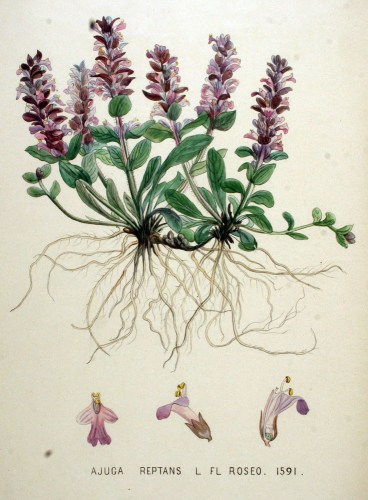
(The image is a botanical illustration of Ajuga reptans.)

Posted in Uncategorized | 1 Comment

Planting Violets in the Rain

Planting Violets in the Rain
by Theodora Goss

The difference between me
and a crazy old woman planting
violets in the rain is — I’m not that old yet.

But there I was, planting violets,
while rain ran down my hair and left water drops
on my glasses. I had been waiting
for the rain to stop, but it had not stopped
for three days, and the violets,
sitting in their cardboard box, roots
wrapped in a damp paper towel, upright
in their plastic bag, open at the top
so they could breathe, were getting impatient.
Lift us out of here, they said. We want
to stretch our toes in the mud,
we want to get cold and dirty,
feel the water on our heart-shaped leaves,
send our purple flowers skyward.
We are delicate, yes, but we are strong —
we were made for storms.
We come back year after year, we invade
your garden with beauty.

What could I say after that?
I was afraid they might invade me,
so I went out in the rain
and planted them, although I was not at all sure
whether I was made for storms,
whether I would come back if a late frost
killed me down to the soil, neither as beautiful
nor as delicate as their nodding stems,
not sure of myself or my ability
to put down roots wherever I was planted,
thinking, if anyone walks by, they will wonder,
who is that crazy woman?

But like them, I was willing
to take my chances.

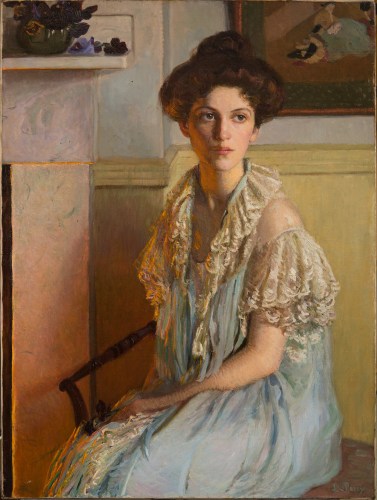
(The image is Lady with a Bowl of Violets by Lilla Cabot Perry.)

Posted in Uncategorized | 1 Comment

Persephone in Hades

Persephone in Hades
by Theodora Goss

Poppies have never been my favorite flowers.
Here they bloom all year long, if one can say
a year in Hades, where no seasons pass,
where summer never fades. Ironic, that —
a land of death where nothing ever dies.

I have almost forgotten how it feels
when snowflakes fall and melt against my cheeks,
when frost spreads her white veil across the landscape,
covering the hills, decorating the leaves
that rattle on the trees with intricate lace.
I miss that time of year when autumn fires
bloom in the household hearths. Here, no fires burn.
Instead, among the wheat, the poppies sway:
an endless field to drug men into sleep,
relieve their pains or worries for a while,
here, in this silent land where all are welcome.

As silent as my husband, Hades himself,
who sits all day in his library reading scrolls
lost to the world above us. “Why did you bring me
to this stagnant country,” I ask him, “if not to talk?
To sit and brood in a chair made out of bones,
or stare out the window at the unchanging garden,
in which only yew trees grow, and never speak?
Why abduct the daughter of Demeter?
Why not some other girl?” He shakes his head
and sighs. He would be handsome, if not so lost
in his own dreams. Or if he would trim his beard.
“I saw your hair lift in the wind,” he says,
“and thought of it blowing back against my face,
but there is no wind down here. I saw your mouth
and thought perhaps it would kiss me, or whisper poems
into my ears. Perhaps then I’d wake up
from this endless sleep, this abyss of timelessness.
I thought you might love me in time, forgetting that love
cannot live in this land.” He looks at me, frowning.
“You’ll never love me, will you, Persephone?”
“Not,” I say, “as long as you keep me here,
while above us frost and snow blanket the earth —
away from death, among the endless dead.”
“Yet how can I let you go?” His eyes plead with me,
I suppose to be forgiven or understood,
but I turn away, unsympathetic. He should
know better: you cannot have love on such terms.
Even the gods, selfish as children, know that.

It is useless, here, to count the days, and yet
a day will come, a day without a dawn,
when I will feel that ache within my chest,
as though a string were tied around my heart,
and know, with crocuses and hyacinths,
it’s time to push my way through the dark soil
into the sunlight, into my mother’s arms.
It’s time to blossom like the olive trees,
be born again into mortality
for a little while, laugh and shake water drops
from my hair, dance across the sunlit meadows
sprinkled with daisies and cornflowers, forget the land
of death and poppies, at least for a little while.

To forget, for a little while, the silent husband
who waits implacably at summer’s end.
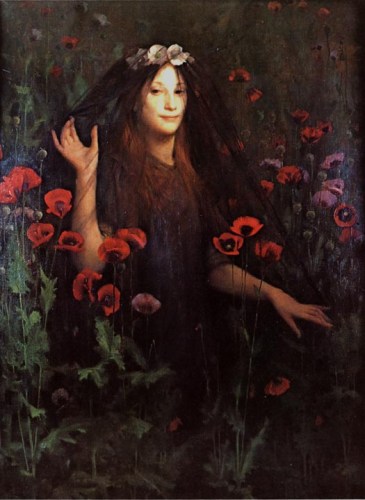
(The image is Death the Bride by Thomas Cooper Gotch.)

Posted in Uncategorized | 4 Comments

The Cinder Girl Burns Brightly

The Cinder Girl Burns Brightly
by Theodora Goss

Each night, her mother speaks to her out of the fire:
come to me, my daughter. Come into the flames.
And the Cinder Girl, the one they call Dirty Ella,
even the housekeeper, even the kitchen maid,
steps into the fireplace. She burns
brightly, hair flaring upward,
skin as white as the heart of the sun itself.
When she emerges, she is as clean as though
she had bathed in lavender water with castile soap.
She must rub soot again all over her body
to disguise herself as the Cinder Girl.

The fire is her mother’s arms, it is the love
in her mother’s breast, as hot as a train furnace.
If you have that kind of love, not even death
can defeat it.

When her stepmother says, sort these peas
from these lentils, the fire says
put them on the hearth, daughter.
She does, and out of the fire
fly two birds, one red, one yellow.
The red one picks out the peas,
the yellow one picks out the lentils,
until they are all sorted.
The Cinder Girl sits there, watching
with flames flickering in her eyes.

When her stepsisters say, mend these gowns,
the fire says again, put them on the hearthstone,
and out of the flames come small white mice,
squeaking, squealing, swarming over the kitchen.
They stitch the ripped hems, the torn bodices,
so neatly and evenly that the seams
are almost invisible.

On the first night of the ball, the fire says,
wear this — it is a dress
as red as passion. If you wear this, the prince
will want to dance with you all night.
The Cinder Girl puts it on, and now she is
a forest fire. She burns through the ballroom.
The prince dances with no one else. But at midnight
she runs back home to her mother.

On the second night, the fire says,
wear this — a dress as yellow as jealousy.
If you wear this, the prince will ask you to marry him.
He does, in the moonlit garden, but once again
the Cinder Girl flees. She does not know
if she wants to spend all night in the arms
of a man she has just met
who likes to play with matches.

On the third night, the fire says,
daughter, you know what to do. This dress
is as white as innocence. The Cinder Girl will shine
like no one else, not that the prince has eyes
for any other woman. Since he was a boy,
he has been attracted to danger and sharp objects:
swords and knives, court gossip,
the game of politics, like his father before him,
who preferred to imprison recalcitrant noblemen,
including the Cinder Girl’s grandfather,
in the castle dungeon. She herself
intrigues him — she is the greatest secret of all.
Who is she? Tonight he calls her
Princess Diamond. In the rose garden,
she accepts his proposal.

She leaves her shoe, covered with diamonds,
under a rosebush.

In three days, the prince and his retinue will ride
up to her door, where her stepmother
will laugh at the idea that Dirty Ella, imagine!
could be the mysterious Princess Diamond. But Cinder
will produce the other shoe out of her pocket.
Miraculously, she will be clean
under her rags, her skin as white as frostbite.
The prince will put her in his carriage, and the household —
stepmother, stepsisters, housekeeper, kitchenmaid —
will gape as they drive off.

She will be married in the white dress. That night,
while the prince is sleeping in a mahogany four-poster
with brocade hangings, she will kneel before the fireplace
of their cavernous bedroom, cold despite the tapestries
on which hunters trap a unicorn with the help
of a virgin, innocent, complicit. She will say, mother,
I am here. Out of the fire will fly two birds,
one red, one yellow, and perch on the carved bedposts,
above the snoring prince. Out will come
a swarm of white mice to scamper around the room,
over the oriental carpets.

The fire will hold out its arms, saying, daughter,
come into my embrace, and the Cinder Girl
will hold out her arms in turn, saying mother, come to me.
She will wrap the fire around her
like a shawl, red, orange, yellow, safe in its warmth,
and burn the palace down.

(The image is a illustration for “Cinderella” by Walter Crane.)

Posted in Uncategorized | 2 Comments