The Eastern Screech-Owl (Megascops asio)

The Eastern Screech-Owl (Megascops asio)
by Theodora Goss

The Eastern screech-owl
has a varied diet. In the wild,
it may consume insects such as cicadas
and crickets, small mammals
(mostly voles and field mice), song birds,
including sparrows and chickadees, sometimes
reptiles and amphibians, frogs especially,
but also lizards, and even crayfish. It hunts
at dusk and dawn, or at night,
while we are sleeping, curtains drawn
against the darkness.

But the Eastern screech-owl is one
with the darkness. Like other owls,
it has exceptional hearing and night vision,
which makes it an excellent hunter. It uses
several strategies: it may perch on a branch
and swoop down to catch its prey,
or chase it in the air for a short distance.
That is how it catches our dreams
as they flutter along on translucent wings,
so delicate, trusting the darkness
to hide them, not knowing
that the Eastern screech-owl, which,
as I have mentioned, is one
with the darkness,
is listening, watching, waiting
to pounce.

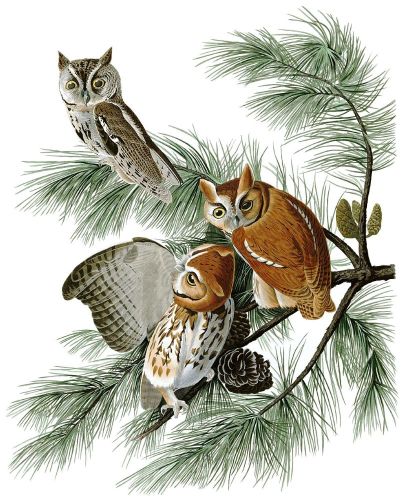
(The image is an illustration of Eastern screech-owls by John James Audubon.)

Posted in Uncategorized | 1 Comment

As Twilight Came to the Park

As Twilight Came to the Park
by Theodora Goss

There was a moment, as twilight came to the park,
when suddenly the lights turned on,
and the birds began to chatter and clatter as they do
just before dawn,

an inverted dawn, a dawn that brings the indigo
twilight falling fast,
and electric lights came on as they used to once,
in the gaslit past.

Then, carriages rolling down the street would bring
proud ladies in feathered hats
to sit on wooden benches beside threadbare
impoverished poets,

while strutting politicians would attempt to settle
important matters of state,
and shopgirls strolling together would linger, determined
to stay out late,

and in one corner, as disapproving nursemaids
watched children intently at play,
university students would argue about the urgent
questions of the day.

As twilight fell, their ghosts started moving along
the gavel paths, to and fro
in their outdated clothes, with their outdated gossip and news
from a century ago,

and I felt as though I sat, on that wooden bench,
at the fulcrum between a past
that was inaccessible and a future that seemed
uncertain at best,

while the ghosts passing to and fro offered no reassurance,
with their ancient loves and wars,
nor the birds, who had sung the same songs in twilights past,
nor the emerging stars.
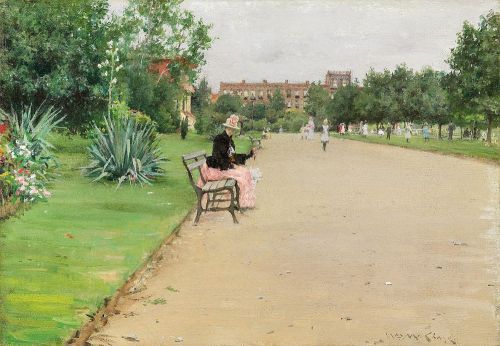
(The image is A City Park by William Merritt Chase.)

Posted in Uncategorized | 1 Comment

The Language of Birds

The Language of Birds
by Theodora Goss

Once upon a time, you knew
the language of birds.
Don’t you remember?
They spoke to you in the morning
and in the evening,
and you could respond
in their own language —
you were bilingual,
like a child raised in Switzerland.
You could speak birdish
and humanish, each with the proper
accent and intonation.
That was before
you realized there was a difference
between you and the trees,
you and the hills
you and the rivers.
Before you decided you were separate
from the creation.
Before you forgot
how to fly.

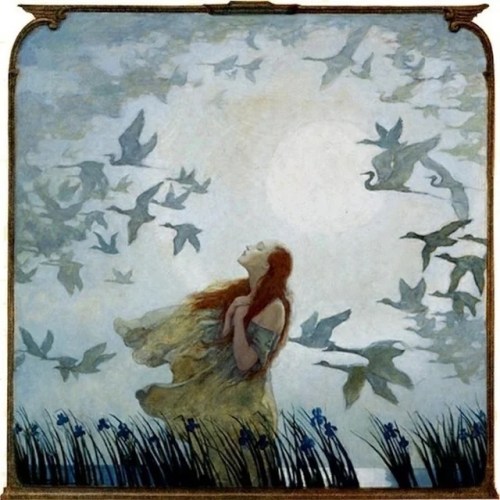
(The image is an illustration by N.C. Wyeth)

Posted in Uncategorized | 4 Comments

In Praise of Complexity

In Praise of Complexity
by Theodora Goss

The eye delights
in these: the corbels under the edge
of the roof of the Nemzeti Múzeum,
which look like furled
bits of foliage, perhaps acanthus leaves
curled in on themselves, and then between
them, purely decorative, the white stone
fleurons, like five-petaled roses, so that beneath
the roof flourishes an orderly garden
which, unexpectedly, includes lions —
their mouths open in a silent roar.
All this just to hold up
the roof, on which pigeons build their nests.

They are equally inhabitants
of the museum park, perching in the chestnut trees,
drinking from the white stone fountain,
rising in aerial ballets,
gray, white, black, brown, some of them
with a ring of green iridescence
around their necks. They are more graceful
than we could ever be. The eye delights, too,
in this complexity: the design
of the pigeons, variegated and variable;
the design of their flight up from the gravel
paths, past running children, to the roof;
the design of the chestnut leaves against the stone
walls of the museum; the ancient windows
with their wavering glass
panes reflecting, irregularly, the branches
moving in the wind, the passing wings.

And then the life everywhere:
the chestnut trees whispering, the clatter
and flutter of the pigeons, parents shouting
after children engaged in the terrestrial ballet
of running after balls. The eye
of the observer sees it all, hears
it all, and also, somehow,
I’m not sure how,
from the stone garden under the roof,
the silent lions roaring.

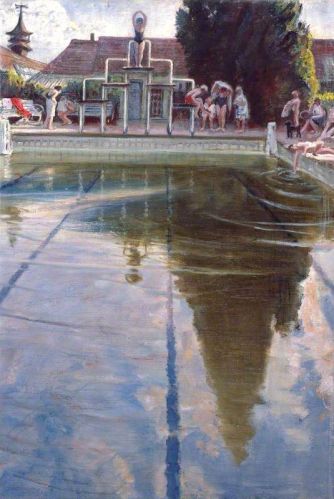
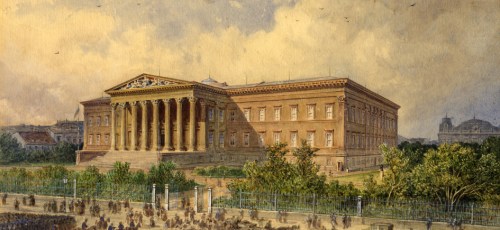
(The image is an old painting of the Magyar Nemzeti Múzeum.)

Posted in Uncategorized | Leave a comment

The Blasted Willow

The Blasted Willow
by Theodora Goss

Several years ago,
the willow by the pond
of the Hall’s Pond Nature Preserve
was struck by lightning.

It split in two, one half
fallen into the water, the other
still standing, its trunk
hollowed out, as though a giant
had scraped out its marrow
for some giant’s banquet
(giants usually being vegetarian,
despite what Jack said). The tree
was probably, I thought,
going to die. It looked so completely
destroyed by a blast that had come
from the sky, as though the gods
were angry with it. What had it done,
what could a willow tree do
to anger the gods, I wondered.
The park maintenance crew
took away its fallen branches.

The following spring,
new branches, fresh and pliant,
began sprouting from what was left
of the trunk. Leaves grew,
the green-on-top, silver-on-the-bottom
leaves of a willow tree,
straight out of Greek myth,
and because the tree
had been blasted, they grew
not up, but out over the water,
as though the dryad of the tree,
learning a lesson from Narcissus,
wanted to look at herself.

In autumn, her leaves fell
on the pond. In spring, her branches
were taller. Three years later,
as I sit beside her, companionably
listening to the buzz of insects
and the distant shout
of volleyball players, she is half
her original height, but still crooked,
still growing hunched over
from her injured trunk,
like an old woman
or a metaphor for resilience.
Some of her branches reach up
toward the sky, defying
whatever forces blasted her
in the first place.
Some of them reach down
to touch the water, as though
she is drinking. She has become
the most beautiful willow tree
at the pond, and the one
I like to sit beside. Teach me,
I tell her, about resilience,
about defying the gods
or giants, about being green
and silver and beautiful,
and not hiding your scars
even after you have been struck
to the heart.

(The image is Water-Lily Pond and Weeping Willow by Claude Monet.)

Posted in Uncategorized | 1 Comment

The Broadleaf Arrowhead (or Duck-Potato)

The Broadleaf Arrowhead (or Duck-Potato)
by Theodora Goss

Oh beautiful! Beside the footbridge, growing
out of the water, are the large green leaves
of a plant called broadleaf arrowhead or duck-potato.
Among them, from the water, rise green stems
called scapes, along which grow its small white flowers,
each with three petals around the yellow stamens,
arranged in whorls along a central raceme
and clustered in a pattern called inflorescence,
like stars against the green. Beneath them float
lenticular leaves of duckweed, like confetti.
An angry catbird is squawking from its perch
among the bulrushes, as though to challenge
my presence in this tangle of summer foliage —
the arrowheads, the dangling orange jewelweed,
the rushes whose stalks, rising from tall green blades,
will, in autumn, produce brown cigars of cattails.

They remind me of the annual transformation
of summer into autumn, and of course,
inevitably, because I am only human,
my own mortality. May I become,
someday, if I am anything, anything at all,
this, right here, despite the annoying catbird —
green leaves and water, the only combination
that never fails, that lasts almost forever.

(The image is an illustration of a broadleaf arrowhead, specifically Sagittaria sagittifolia.)

Posted in Uncategorized | Leave a comment

How to Create a Monster

How to Create a Monster
by Theodora Goss

First you must learn how to sew.
He had never learned, you see —
no, not he, the mad-for-science boy,
for whom I was just another
pretty toy, his Elizabeth,
his Liz, Betty, Sissy, his pet
cousin, almost sister.
My dear Victor Frankenstein,
you need to be able to sew
with thread so fine
it is almost invisible,
as thin as the hair
of a Swiss miss, or the air
at the top of a glacier.
I learned how, of course,
from your mother.

How to make the little stitches
like bird tracks, mouse tracks.
While you were reading your books
of alchemy, I was making and mending.
While you were wandering
over the hills around Geneva,
dreaming great dreams — university,
breaking the bounds of human knowledge,
etcetera, I was sitting
by a window, embroidering
a handkerchief, or darning your sock,
watching long, slow minutes pass
on the mantle clock.

But I learned how to sew.
I can make stitches so fine,
you cannot see them. I will take
this lifeless girl, this Justine,
and make her, remake her,
into a companion. I will mend
her, you’ll see. And then we will roam
the hills together, whatever
the weather — monsters don’t care
about that. They only care
about the essential things, like how to find
birds’ nests in spring, berries
and nuts in autumn. We will live
off the land, like feral goats,
climbing the steep cliffs,
dressed in warm coats
of felted wool. If you see us lingering
by a mountain pool, look away.
Monsters don’t like to be watched.
We will talk
about Paradise Lost together.
(You would never
discuss it with me. What,
isn’t my brain good enough for you,
Victor, you thick-fingered blunderer?)

You messed up, clearly. But I, trained
as a seamstress, reading your books
surreptitiously, while you were out
being a Romantic hero — I,
the heroine of no story, at least not my own,
just a minor character in your narrative —
I can sew beautifully. You’ll see.

They will ask, who is the monster,
Elizabeth or her creation? But we will already
have disappeared into the mountains.

(The image is The Sunny Window by Frank W. Benson.)

Posted in Uncategorized | 1 Comment