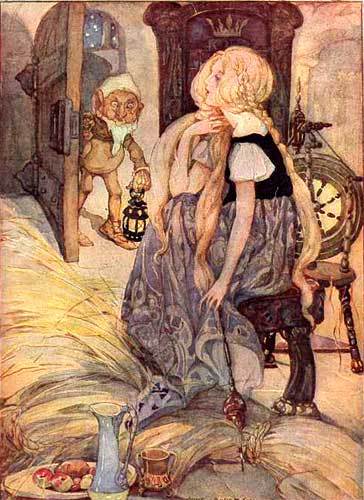
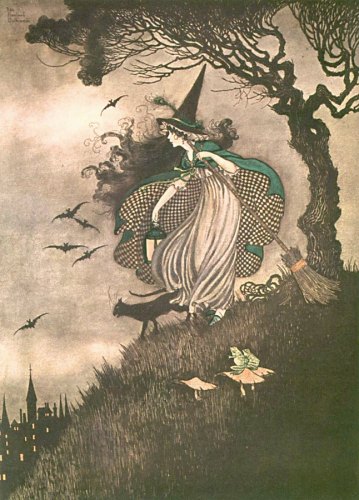
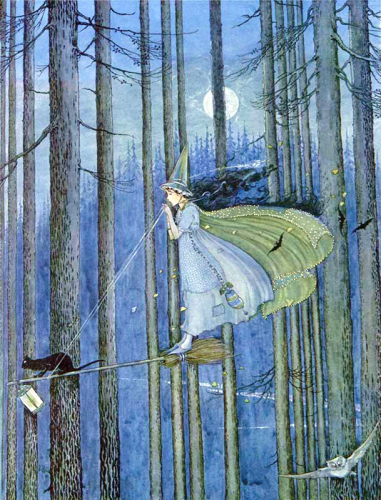
How to Make It Snow

How to Make It Snow
by Theodora Goss

First you must fall down the well.

At the bottom of the well
is the country at the bottom of the well.
That is its name, the only one it has.
You have two names, either the beautiful girl
or the kind girl, depending
on what day it is.

At the bottom of the well is a green meadow,
just like in the country you came from
but different. For one thing, the cows can speak.
They say, “Scratch our backs, scratch us
under the chin,” and you do.

The meadow is filled with poppies
and cornflowers. The air is warm,
and the sun is shining.

“Thank you, beautiful girl,” say the cows
and you walk on.

Across the meadow, there is a narrow path
worn by cow hooves. Follow it.

First you come to the oven.
“Take me out, take me out,” cries the bread.
“I’m burning up!” You take it out,
a brown wholemeal loaf. Carry it with you
for the birds — they appear later.

Next you come to the apple tree.
“Shake us down, shake us down,” cry the apples.
“We’re ripe!” So you shake the branches, as though
you were dancing with them.
The apples come tumbling down.
You put three in your pocket.

Now you are at the edge of the forest
and the birds call, “Feed us, feed us!”
You ask the loaf, “May I?”
“This is what I was baked for,” says the loaf.

So you scatter breadcrumbs
and the birds come, sparrows and chickadees,
robins and finches and juncos,
and a nuthatch. They perch on your arms
as you feed them. Absentmindedly,
you whistle as they do.

In the forest, a wild sow approaches.
For the first time you are afraid and step back,
but she says, “My little ones are hungry,
and I smell something sweet.”
You pull the apples out of your pocket.
“May I?” you ask, and the apples reply,
“This is why we fell.”

You kneel while the sow watches protectively,
feeding the apples to her three piglets,
bristle-backed, with tusks just starting to form
but still striped as though someone had marked them
with her fingers. The sow nods and says,
“You are a kind girl.” Then, followed by her progeny,
she disappears into the trees.
You continue alone.

It is getting dark. You have passed through the oaks
and now it is all pines. You are walking on needles.
The light is fading when you come to the cottage.
It looks like the cottage out of a fairy tale:
peaked roof like a witch’s hat, dark green trim,
small-paned windows through which firelight is flickering.
Someone is waiting for you.

You have nothing left, no bread, no apples.
So you knock.

The woman who answers is old, small,
like a doll made of cornhusks.
“You’re hungry,” she says,
“and tired. Come in, my dear.
The soup is almost ready.”

There is a fire, and a cauldron on the fire,
and a chair by the fire, and a cat in the chair,
and you can smell the soup.

“Come on, then,” says the cat, and gets up,
but only to settle again in your lap
once you sit down.

Here are the things you know about the old woman:
she milks the cows, she causes the apples to ripen,
she teaches the birds their songs, she runs her fingers
along the backs of the wild piglets
to put the stripes on them.

Here are the things she knows about you:
everything, also your name.

“What are you called, my dear?” she asks.
“The beautiful girl,” you answer. “Or the kind girl.”
“No,” she says. “From now on, you shall be
she who makes it snow.
Or Holle, for short.”

Holle: it suits you.

“Here’s what I’d like you to do tomorrow morning.
Sweep the floor and dust the shelves,
wash the curtains and wind the clock,
polish the silver. And when that’s done,
shake out my bedspread until the feathers
fly like snowflakes. It’s time for winter.
Can you do that?”

You nod. Yes, of course.

That night you sleep under the cat,
in her attic bedroom.

The next morning, you put on an apron she left for you,
then sweep the floor and dust the shelves,
wash the curtains in a metal basin,
wind the clock and polish the silver. Finally,
you stand on the cottage steps under tall pines
and shake out the old woman’s bedspread.

Snow falls and falls, until
the forest is silent.

“Well done, my dear.” She’s wearing a gray wool coat
and carrying a battered suitcase. “Can you do that again
tomorrow morning, and the day after tomorrow?
I need to visit my sisters, and I’m not sure
when I’ll be back yet.
It takes a responsible girl, but I’ve heard good things
about you from the cows, the bread, the apples,
the birds, even the trees. And the cat likes you.”

“I’ll do my best,” you say.
She kisses you on both cheeks, then rises up, up,
through the trees until she is only a speck
in the colorless sky.

You go back into the cottage.
There is a cat to scratch under the chin,
and books with stories you have never read,
and you haven’t introduced yourself to the clock yet.

Besides, you like your new name.
It’s the right name for a woman
who makes the snow fall.
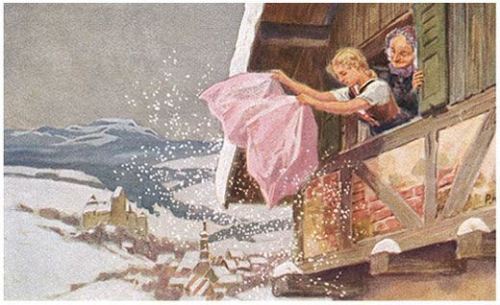
Illustration for Frau Holle

(The image is an illustration for “Frau Holle” from Nursery and Household Tales by the Brothers Grimm.)

Posted in Uncategorized | 3 Comments

Lady Winter

Lady Winter
by Theodora Goss

My soul said, let us visit Lady Winter.

Why? I responded. Look, the leaves still lie
yellow and red and orange in the gutters.
The geese float on the river. On the sidewalks,
puddles continue to reflect the sky.

My soul said, the branches are bare.
And you can feel it, can’t you, in your bones?
The chill that is a promise of her coming.
The year is growing older. Anyway,
you haven’t seen her in so long: it’s time.

We put on our visiting hats.
I stood admiring myself in the mirror
while my soul stood beside me looking pensive
and pale. Was she a little sick? I wondered.

Lady Winter lives on an ancient street
lined with elms that canker has not touched,
in a tall brownstone with lace curtain panels,
empty window boxes, two stone lions.
We rang the bell and heard it echoing.

A maid opened the door. Her name is Frost.

My lady looked the way she always does:
white hair, a string of pearls, rings on her fingers,
age somewhere between forty and four thousand,
a kind, implacable smile.

She said, my dear, what’s wrong? You don’t look well.
What, me? I’m fine. Perfectly fine, I said.
My soul just shook her head.

My lady has a parlor with a fireplace
in which I’ve never seen a fire. Instead,
it’s filled with decorative branches. Doilies
lie like snowflakes on the tables, bookshelves,
over the backs of armchairs.

She’s always wearing a gray cashmere sweater
and expensive shoes. She must have a closetful.

She usually serves us tea and ladyfingers.
But this time she said, I want you to go to bed.

Frost will take you upstairs, then I’ll come up
to cover you in blankets of felted wool,
comforters stuffed with down from eider ducks
that nest by Norwegian fjords. I’ll read you books
of fairytales about bears and princesses,
and stolen crowns, and castles beneath the sea,
and northern lights.
Grandmothers who grant wishes, talking reindeer,
a village in the clouds.

I’ll talk to you until you fall asleep.
Your soul will sit and watch through the long night.
From time to time she’ll take your temperature
to make sure you’re all right.

So I lay down in Lady Winter’s guest room:
reluctantly, but it looked so inviting,
a bed with draperies and a painted ceiling
from which the moon was hanging
by a silver chain.

My soul sat down beside me.
Don’t worry, she said. There’s plenty for me to do.
Poetry to embroider, plans to knit.
I’ll wake you when the crocuses have broken
through the black soil, when warmth has come again.

Then Lady Winter put her soft, dry hand
like paper on my forehead
and she said
rest now.

Image by Elizabeth Sonrel

(The image is by Elizabeth Sonrel.)

Posted in Uncategorized | 2 Comments

Snow White Learns Witchcraft

Snow White Learns Witchcraft
by Theodora Goss

One day she looked into her mother’s mirror.
The face looking back was unavoidably old,
with wrinkles around the eyes and mouth. I’ve smiled
a lot, she thought. Laughed less, and cried a little.
A decent life, considered altogether.

She’d never asked it the fatal question that leads
to a murderous heart and red-hot iron shoes.
But now, being curious, when it scarcely mattered,
she recited Mirror, mirror, and asked the question:
Who is the fairest? Would it be her daughter?

No, the mirror told her. Some peasant girl
in a mountain village she’d never even heard of.

Well, let her be fairest. It wasn’t so wonderful
being fairest. Sure, you got to marry the prince,
at least if you were royal, or become his mistress
if you weren’t, because princes don’t marry commoners,
whatever the stories tell you. It meant your mother,
whose skin was soft and smelled of parma violets,
who watched your father with a jealous eye,
might try to eat your heart, metaphorically —
or not. It meant the huntsman sent to kill you
would try to grab and kiss you before you ran
into the darkness of the sheltering forest.

How comfortable it was to live with dwarves
who didn’t find her particularly attractive.
Seven brothers to whom she was just a child, and then,
once she grew tall, an ungainly adolescent,
unlike the shy, delicate dwarf women
who lived deep in the forest. She was constantly tripping
over the child-sized furniture they carved
with patterns of hearts and flowers on winter evenings.

She remembers when the peddler woman came
to her door with laces, a comb, and then an apple.
How pretty you are, my dear, the peddler told her.
It was the first time anyone had said
that she was pretty since she left the castle.
She didn’t recognize her. And if she had?
Mother? She would have said. Mother, is that you?
How would her mother have answered? Sometimes she wishes
the prince had left her sleeping in the coffin.

He claimed he woke her up with true love’s kiss.
The dwarves said actually his footman tripped
and jogged the apple out. She prefers that version.
It feels less burdensome, less like she owes him.

Because she never forgave him for the shoes,
red-hot iron, and her mother dancing in them,
the smell of burning flesh. She still has nightmares.
It wasn’t supposed to be fatal, he insisted.
Just teach her a lesson. Give her blisters or boils,
make her repent her actions. No one dies
from dancing in iron shoes. She must have had
some sort of heart condition. And after all,
the woman did try to kill you.
She didn’t answer.

And so she inherited her mother’s mirror,
but never consulted it, knowing too well
the price of coveting beauty. She watched her daughter
grow up, made sure the girl could run and fight,
because princesses need protecting, and sometimes princes
are worse than useless. When her husband died,
she went into mourning, secretly relieved
that it was over: a woman’s useful life,
nurturing, procreative. Now, she thinks,
I’ll go to the house by the seashore where in summer
we would take the children (really a small castle),
with maybe one servant. There, I will grow old,
wrinkled and whiskered. My hair as white as snow,
my lips thin and bloodless, my skin mottled.

I’ll walk along the shore collecting shells,
read all the books I’ve never had the time for,
and study witchcraft. What should women do
when they grow old and useless? Become witches.
It’s the only role you get to write yourself.

I’ll learn the words to spells out of old books,
grow poisonous herbs and practice curdling milk,
cast evil eyes. I’ll summon a familiar:
black cat or toad. I’ll tell my grandchildren
fairy tales in which princesses slay dragons
or wicked fairies live happily ever after.
I’ll talk to birds, and they’ll talk back to me.
Or snakes — the snakes might be more interesting.

This is the way the story ends, she thinks.
It ends. And then you get to write your own story.

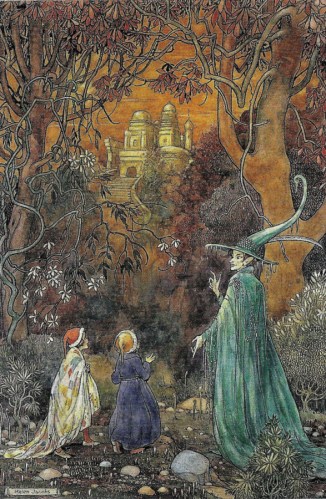
The Enchanted Wood by Helen Jacobs

(The image is The Enchanted Wood by Helen Jacobs.)

Posted in Uncategorized | 8 Comments

The Gold-Spinner

The Gold-Spinner
by Theodora Goss

There was a little man, I told him.

I gave the little man my rosary,
I gave the little man my ring,
my mother’s ring, which she had given me
as she lay dying. A thin circlet of gold
with a garnet, fit for a commoner.

As I was a commoner, I reminded him.
Nothing magical about me.

Very well, he said. You may go
back to your father’s mill. I have no use
for a miller’s daughter without magic in her fingers.
I’ll keep the three roomfuls of gold.

I walked away from the palace, still barefoot,
still dressed in rags, looking behind me
surreptitiously, afraid he would change his mind.
Afraid he would realize he’d been tricked.
I mean, what kind of name
is Rumpelstiltskin?

But he would have kept me spinning
in a succession of rooms, forever.

I passed my father’s mill without entering,
either to greet or berate. I wanted you to be queen,
he had told me, after I said how could you
betray me like this?
You deserve that, you deserve better
than your mother. What kind of life
did I give her?

No, I wasn’t going back there.

By mid-afternoon I had left the town,
I had forded the river, I had come
to unfamiliar fields. I sat me down
by a hedge on which a few late roses bloomed
and from a thorn I plucked a tuft of wool
left by a passing sheep. I spun,
twisting it between my fingers
as my mother had taught me.
She, too, had the gift.

I coiled the resulting thread
of thin, soft gold
around my wrist. Somewhere along the road
it would buy me bread.

Until then, there were crabapples
and blackberries to share with the birds.
And the road ahead of me,
leading I knew not where, but somewhere different
than the road behind.

Illustration for Rumpelstiltskin by Anne Andersen

(The illustration is by Anne Andersen. Except in my poem, of course, there is no little man . . .)

Posted in Uncategorized | 5 Comments

The Stepsister’s Tale

The Stepsister’s Tale
by Theodora Goss

It isn’t easy, cutting into your feet.

Years later, when I had become a podiatrist,
I learned the parts of the feet. Did you know your feet
contain a quarter of your bones? Calcaneus, talus, cuboid, navicular.
Lateral, intermediate, and medial cuneiform.
Metatarsals and then the phalanges, proximal, middle, distal.
They’re beautiful on the tongue, these words from a foreign language.

My sister cut into her heels, which are in the hindfoot.
I cut into my big toes, called the halluces.
She cut into flesh and tendon and sinew.
I cut into bone, between the phalanges,
through the interphalangeal joint.
That’s in the forefoot, which bears half the body’s weight.
To this day, both of us walk with a slight limp.

The problem is you do desperate things for love.
We loved her, the woman who wanted us to be perfect:
unblemished skin, waist like a corsetier’s dream,
feet that would fit even the tiniest slipper.
And so we played the aristocratic game
of identify-the-princess.

Sometimes it’s a slipper, sometimes a ring.
Oh mother, love me without asking me to scrape
my fingers like carrots, cut off my heels and toes.
Eventually, she became your favorite daughter,
the cinder-girl, the princess-designate.
She was the best at being perfect, but abuse
will do that to you.

A woman comes into my office, asking me
to cut off her little toes so she can wear
the latest fashion. I sit her down and say
did you know your feet provide the body
with balance, mobility, support?
Come, let me show you a model: here’s the toe,
metatarsal and phalanges. You can see
how elegantly they move, as in a waltz,
surrounded by your blood vessels and nerves,
the ball gown of your soft tissue,
a protective coat of skin, the delicate nail.

Look, underneath, how beautiful you are . . .

Illustration for Cinderella by Charles Folkard

(This illustration is by Charles Folkard, for an edition of Grimms’ fairy tales.)

Posted in Uncategorized | Leave a comment

The Witch-Girls

The Witch-Girls
by Theodora Goss

The witch-girls go to school just down the street.
I see them pass each morning with their brooms
and uniforms: black dresses, peaked black hats.
They giggle just like ordinary girls,
except that as they walk, their brindled cats
twine around their ankles. One will stop
and say, “You’ll trip me, Malkin,” scoldingly.
Then Malkin will look up and answer back,
“Carry me then.” The witch-girl will bend down,
scooping the cat into her arms, and perch
him on her shoulder. So the witch-girls pass.

I wish I could be one of them. Alas,
I don’t know how to fly on windy nights
or talk to bats, or brew a magic potion.
Although I think I could be good at witching.
I’d learn to curse and never comb my hair.
I’m pretty good at scaring passers-by
by making goblin faces through the window.
I’d trade white cotton dresses for black wool,
no matter how it itched. I’d fly my broom
up to the witches’ garden on the moon
where they dance nightly, kicking up their heels
with sylphs and fauns and ghouls. At least I think
that’s what they do. I don’t think witches go
to bed at nine, or even make their beds
each morning. No. Instead, they marry toads,
or live alone and read old books. They paint
landscapes in Germany, or climb the Alps,
or sit in Paris cafés eating chocolate
for lunch and maybe dinner. They get drunk
on elderberry cordial, speak with bears
on earnest topics like philology.
I wonder what the witch-girls learn in school?
Geometry that helps them walk through walls,
and how to turn a poem into a spell . . .

I wish that I could go to school with them.
I’d giggle and be wicked too, if they
would only let me.

(This image is The Little Witch by Ida Rentoul Outhwaite.)

Posted in Uncategorized | Leave a comment

Why You Might Be a Witch

Why You Might Be a Witch
by Theodora Goss

Because sometimes you dream of flying
the way you used to.

Because the traffic light always changes for you.

Because when you throw the crusts of your sandwich
to sparrows in the public park, they hop close
and closer, until they perch on your finger
and look at you sideways.

Because as you walk down the street,
the wind plays with the hem of your skirt
so it swings dramatically around your ankles.

Because as you walk, determined and sensible,
your shadow is dancing.

Because a lot of people talk to cats
but for you they answer.

Because the sweetgum trees along the sidewalk
love to show you their leaves, sometimes even tossing
them in front of you, yellow veined red,
brown shot with green and yellow,
like children showing off artwork.

Because when you look up,
the moon is always smiling.

Because sometimes darkness closes around you
and you remind yourself that it’s all right,
you’ve worn this cloak before.

Because in winter you acknowledge
that snow is a blanket as well as a shroud,
and we must all sleep sometimes.

Because in spring you can hear the tinkling bell-sounds
that crocuses make, and the deeper gongs of the tulips.

Because the river waves to you in passing,
and you wave back.

Because even the brownstones of this ancient city
look at you with concern: they want to make sure you’re well.
You belong to them as much as they to you.

Because witches know what they are
and if I asked, do you remember?
You would have to confess that yes,
you do.

Witch by Ida Rentoul Outhwaite

(The illustration is by Ida Rentoul Outhwaite.)

Posted in Uncategorized | 28 Comments