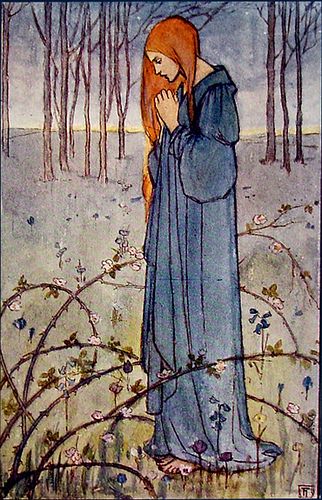
Isolde in the Forest

Isolde in the Forest
by Theodora Goss

Isolde walked among the leafless trees.
A month ago, the aspen had been green
and quivering like a maiden at the touch
of her first lover. Then the grove of oaks
had rustled its red leaves like dowagers
whispering gossip, and the stream had run
between moss-covered banks. How they had changed.
The aspen stood, a slender, shaking thing
stripped of her robes. The oaks stirred silently.
The stream now flowed between bare earth and rock.
All had turned gray, and where not gray then brown.
Just like my love for Tristan, she thought, and his
for me. And as she thought and walked and thought,
the chill wind nipping at her fingertips
and her thoughts growing colder than the wind,
high in the oaks a squirrel chirred, and a bird
called from the aspen, and a drop of rain
fell on the stream’s blank surface, promising
that spring would come again.

illustration-by-arthur-rackham-woman-in-woods

(The illustration is by Arthur Rackham. This poem was published in my collection Songs for Ophelia.)

Posted in Uncategorized | 1 Comment

I Have Walked Alone

I Have Walked Alone
by Theodora Goss

I have walked alone
between the rain and the rain,
unable to explain.

I have walked alone
where the sun touched the tops of the trees
and a breeze
ruffled the grasses at my feet,
thinking: it has been sweet
but it is done.

And down the muddy lane,
listening to a chickadee’s two notes,
unable to explain

what it all meant, even
whether it mattered.
Meanwhile, the sun
shone through the tops of the trees,
red and yellow and brown,
as though through an autumnal
cathedral window.

Suddenly, the birds broke forth,
robin and nuthatch and oriole,
into a hymn.

And it was enough
without more, without
an explanation.

girl-in-thorns-by-emma-florence-harrison

(The image is Girl in Thorns by Emma Florence Harrison.)

Posted in Uncategorized | 1 Comment

Nymphs Finding the Head of Orpheus

Nymphs Finding the Head of Orpheus
by Theodora Goss

The water has a dim and glassy hue.
A mass of airy bubbles clings to curls
that tumble through the river-bottom’s marls,
and cypresses hang heavy with their woe.

Our hair-tips touch the water’s urgent tow
as we lift this possessor of blue lips
and single eye that out its substance weeps,
from the dark river bound by thorny may.

Now sing, my sisters, piercingly and slow,
and sweetly as the honey of the comb,
for this rank weed, and beat the hollow drum,
and kiss and turn the leprous cheeks away.

nymphs-finding-the-head-of-orpheus-by-john-william-waterhouse

(The painting is Nymphs Finding the Head of Orpheus by John William Waterhouse. I wrote this poem a long time ago, but I’m almost certain it was inspired by the Waterhouse painting. It can be found in my collection Songs for Ophelia.)

Posted in Uncategorized | Leave a comment

Autumn, the Fool

Autumn, the Fool
by Theodora Goss

The leaves float on the water like patches of motley.
Autumn, the fool, has dropped them into the lake,
where they rival the costume, not of the staid brown duck,
but the splendid drake.

He capers down the lanes in his ragged garments,
a comical figure shedding last year’s leaves,
but as he passes the crickets begin their wailing
and the chipmunk grieves.

The willow bends down to watch herself in the water
and shivers at the sight of her yellow hair.
Autumn the fool has passed her, and soon her branches
will be bare.

autumn-landscape-with-four-trees-by-vincent-van-gogh

(The image is Autumn Landscape with Four Trees by Vincent van Gogh.)

Posted in Uncategorized | Leave a comment

The Witch’s Cat

The Witch’s Cat
by Theodora Goss

A witch’s cat isn’t always black.
Mine is an elegant tortoiseshell.
She refuses to come when I call to her,
but as soon as I start reciting a spell,
she’ll appear at the top of the stairs,
as though she was never gone at all.

Where does she go when she’s not with me?
She won’t tell me, however much I ask.
Whether for pleasure or to fulfill
some secretive, inscrutable task
given to her by Mother Night.
She simply says, “You’ve made a mistake,

Mistress mine. I was always here,”
then looks at me with those yellow eyes,
like two full moons. A witch’s cat
isn’t always truthful, but she is wise.
She knows where magical plants are found
and when the midsummer sun will rise.

She knows which toads are poisonous
and how to pronounce the ancient words,
whether Latin, Greek, or Sumerian.
She understands the weather’s moods,
and knows the way to the hidden glade
where witches meet, in the heart of the woods.

There we catch up on the latest charms,
sharing ingredients and recipes,
then dance until the moon has set,
while Mother Night walks beneath the trees,
a tall, pale woman as old as time,
whose long black hair is filled with stars.

When my cat says, “Mistress, it’s time to go,”
she climbs on the back of my broom, and we fly
over the sleeping town below,
through a purple and orange sky,
back home, where I promptly get to work,
while she curls in the armchair and sleeps all day!

A witch’s cat is never good,
nor ever entirely bad. She’s herself.
Sometimes she’ll suddenly walk through walls
or appear on the highest shelf
where I hid the cream and knock it down,
more troublesome than any elf.

But what would I do without her? Who
would translate when I summon a demon,
or frighten mice from the herbs in the pantry,
or watch over my simmering cauldron?
Or keep the loneliness away,
a magic stronger than any potion?
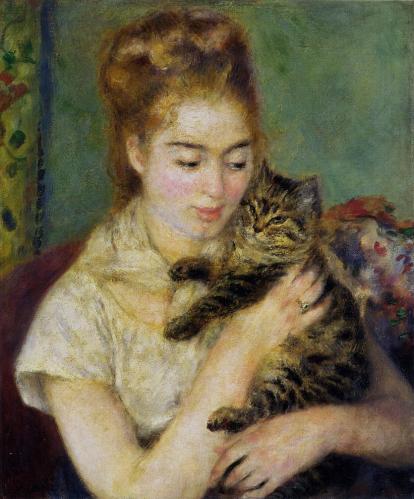
woman-with-a-cat-by-pierre-auguste-renoir

(The image is Woman with a Cat by Pierre-Auguste Renoir. The cat in the painting is a tabby, not a tortie, but I couldn’t find a painting of an actually tortoiseshell . . . even though I think they’re among the most beautiful cats!)

Posted in Uncategorized | 3 Comments

The Witch’s Warning

The Witch’s Warning
by Theodora Goss

This ground is cursed.  I would leave it,
if I were a man, as you are:
leave the moss-overgrown
stones that bound the estate,
leave the damp of the hollow,
leave the hill where a scar
reminds you that penance is needed,
even if proffered late.

You will not listen to me,
to the woman with rain in the tangles
of hair escaping her kerchief
who watches with answerless eyes.
You ride, young lord, through the shadows
of immemorial beeches:
all yours, all yours, but I’d leave them,
young lord, if you were wise.

Ride to the white mausoleum
where your ancestors wait to receive you,
ride past the marshy expanses
where frogs make ominous sounds,
ride passed the ruined hillside
without a notion of pity,
without remorse, to the manor,
satisfied with your rounds.

The tree that stood on that hillside
was older than this structure,
older than your right here
or your family’s name.
All your ancestors shivered
at the fall of that timber,
whose trunk is hewn for a pleasure-house,
whose branches roast your game.

Go to the church with the steeple
and sleep among downy pillows;
the gods that are older than boundaries
are opening up their eyes.
They meet in the damp of the hollow,
they dance on the marshy expanses
where their feet make no dint on the turf
and the air seems filled with sighs.
You would leave, young lord, you would leave here,
if you, like me, were wise.

The West Wind by Walter Crane

(The image is The West Wind by Walter Crane. This poem appeared, in a slightly different form, in my collection Songs for Ophelia.)

Posted in Uncategorized | 2 Comments

To a Friend I Have Not Seen for a Long Time

To a Friend I Have Not Seen for a Long Time
by Theodora Goss

What are the clouds doing
where you are?
Are they building castles
high in the blue dome
we call the sky?
Are they forming themselves
into landscapes?

What is the sea doing?
Has it stopped, even for a moment,
crashing into and slowly,
slowly wearing away the shore?
Is it still smoothing
shells, pebbles?

Is the yarrow blooming
in the side yard, like small
yellow buttons?

Are the sea oats on the dunes
rattling their seed pods,
as though telling the world
be quiet, there is value
in just listening?

Is the paint on the old clapboard house
wearing away? And are the pelicans
still hanging suspended
in the air, like kites
flown by invisible children?

What are you doing with your life?
Tell me all the news:
everything that has been happening
to you, and not happening,
which is, potentially,
more important.

Eleanor, 1907 by Frank Weston Benson

(The image is Eleanor, 1907 by Frank Weston Benson.)

Posted in Uncategorized | Leave a comment