The Pond Beneath the Willows

The Pond Beneath the Willows
by Theodora Goss

I found a secret pond beneath the willows
where the ground was carpeted with creeping charlie.
Reeds grew around it, and in the lake beyond
were the leaves, floating on the water, of waterlily.
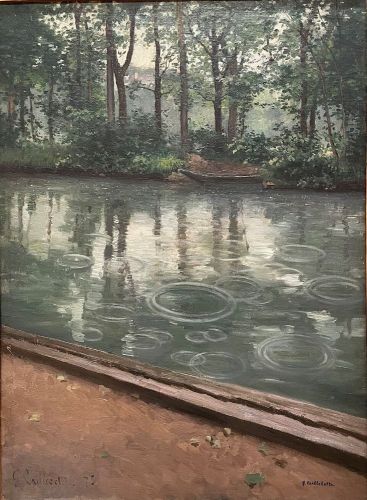
The rain dripped from the willows, slowly, slowly,
starting ripples like in that painting by Caillebotte,
and I thought that everything in nature is perfect, really,
whether or not you can capture it in art.
For a moment I felt as close to true contentment
as I think is possible on this troubled Earth,
and I did not care about things like death or dinner
while raindrops fell in plonking quarter notes
and the crickets began their chirping, and the hidden birds
called to each other, saying the storm was done,
and I stood for a while in that resplendent stillness,
and I did not want to go home.

(The image is The Yerres, Effect of Rain by Gustave Caillebotte)

Posted in Uncategorized | 2 Comments

Theoretical Physics

Theoretical Physics
by Theodora Goss

Maybe gravity
is how the Earth loves us,
holding on to us,
bringing us back to her
no matter how high we jump
or fly, like a careful mother
with her arms stretched out,
always catching us,
as she continually catches
avalanches and waterfalls,
and every seed that journeys
on the billows of the air,
and rain returning from the clouds,
and every leaf that floats
from among the branches to lie
upon the grass, and every blossom,
and even the birds,
with their illusion of perpetual rising,
even eventually her own daughter,
the rebellious moon,
who left home so long ago,
always bringing us
back into her arms,
back into her embrace.

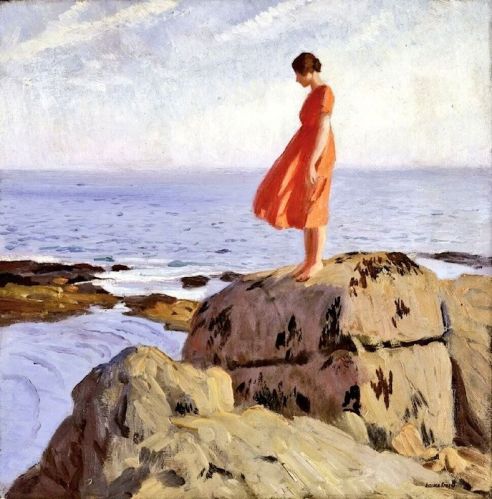
(The image is A Dark Pool by Laura Knight.)

Posted in Uncategorized | 1 Comment

String Quartet

String Quartet
by Theodora Goss

The violin speaks to the violin
and the viol interrupts. The cello
adds its opinions, intermittently.
They are like a dysfunctional family,
arguing with one another,
saying different things, and yet
out of disharmony comes harmony,
like a father and mother going to a party
with their two daughters, one insisting
she is a princess, the other prancing
like a pony while her mother is trying
to put on her coat, the father saying
once again in his sonorous voice
they should have left fifteen minutes
ago, really don’t you know
it’s time, it’s past time.

(The image is Family Portrait (The Bellelli Family) by Edgar Degas.)

Posted in Uncategorized | Leave a comment

The Nest

The Nest
by Theodora Goss

I found a nest
about the size of my hand
fallen to the ground in the park
around the Magyar Nemzeti Múzeum,
which contains artifacts from throughout
Hungarian history — starting
with the Neolithic, through Ottomans
and Hapsburgs to the twentieth
century, from flint tools to Soviet stars,
telling a story of migrations,
continual rebellions, numerous wars,
showcasing human ingenuity.

It had fallen, no doubt,
from one of the poplar trees.
It was empty — the nestlings
had already flown
earlier in the summer. But what artistry
their mother and father
had put into this small vessel,
this receptacle of their most precious
speckled eggs! How intricately
they had woven dried grasses,
small twigs, bits of string,
their own feathers, and covered it
with the fluff that falls
from poplar trees, like summer snow.
It was, as nests go,
a masterpiece.

I brought it home
because there was no place in the museum
for a bird’s nest, however Hungarian
the birds (which might, after all
have been migrants), however intricate
the artifact.

(The image is Bird’s Nest with Sprays of Apple Blossoms by William Henry Hunt.)

Posted in Uncategorized | 1 Comment

In the Mátra

In the Mátra
(for Norbert)
by Theodora Goss

The rock ladies
thought it was rude
when I asked about their age.
“How old are these rocks?” I asked.
And of course they heard me,
the craggy, lichen-covered rock ladies
with moss growing over their bodies,
lying among the grasses where butterflies
were fluttering their evanescent way,
sipping from purple and yellow flowers,
gone in a season. But the rock ladies
sleep long and deep, remember glaciers.
Their faces are pitted and pock-marked.
They know ancient stories
from when these mountains reached
to the sky and they could drink
directly from the clouds.
“Who does she think she is?” they said
to each other. “Landing here on us
like one of those butterflies,
and just as obnoxious.
Never mind. She’ll be gone soon.”

(The image is The Rocks by Vincent Van Gogh.)

Posted in Uncategorized | 2 Comments

Approaching Budapest (Again)

Approaching Budapest (Again)
by Theodora Goss

City of my heart, I am flying to you at a hundred
miles an hour, while below you lie dreaming,
wearing the Danube like a sash around your ball gown,
the one you fell asleep in last night, or was it during
the last century, when you went waltzing
with Vienna, one of those oom-pah-pah waltzes.
You are beautiful in your long sleep, like the princess
in the rose garden protected by thorns.
I will not wake you up, I don’t think anyone
could wake you up now, unless perhaps History
comes along once again, prancing on his black horse
or riding a tank, the way he has a hundred times
before, mowing down both thorns and roses.
But for today at least, may you dream on
among your spires and cupolas, a vision
of green water and sunlit stone, and the linden trees
that spread their perfume over the city parks,
with the bees buzzing (in Hungarian).

(The image is Lady Sleeping by Franciszek Zmurko.)

Posted in Uncategorized | Leave a comment

St. Mary Abbots, June 13, 2025

St. Mary Abbots, June 13, 2025
by Theodora Goss

In the nave of St. Mary Abbots,
students from the Royal College of Music
are playing a lunchtime concert —
Schumann, Haydn, and a French composer
named Milhaud, whom I’ve never heard of.
The air smells pleasantly of old pages,
like a used bookstore. Above the altar,
the crucified Jesus and his disciples
listen intently, also enjoying the music.
The saxophone is dripping notes like honey
from the comb, as slow and liquid and sweet.
The violin has turned into a nightingale;
the piano is a river — but wasn’t it always?
The cello is dancing in a magnificent garden,
and now the violins are twin princesses
dressed in white cotton throwing golden balls,
tossing and never failing to catch them.
The clarinet has taught you how to hear
in a new way that does not seem to involve
ears at all. Your fingertips are listening,
and the tip of your nose, and your eyelashes.
Somewhere, mountains are growing.
The stones of the city are vibrating
like violin strings, the clouds have become angels,
and all the people sitting in the pews,
from the old woman with her walker
to a child sleeping in his mother’s lap,
are wearing haloes. Yes, the air smells
like the pages of old books, and the notes
played by the string quartet rise
up to the gothic vault of the church like prayers.

Elsewhere there are wars and children starving
as usual, and even Haydn cannot prevent
the blare of an ambulance in the middle of the adagio.
But here the music goes on, as it did
on the deck of the Titanic — as it always does.

(The image is a painting of St. Mary Abbots by Elizabeth Gladstone.)

Posted in Uncategorized | 1 Comment