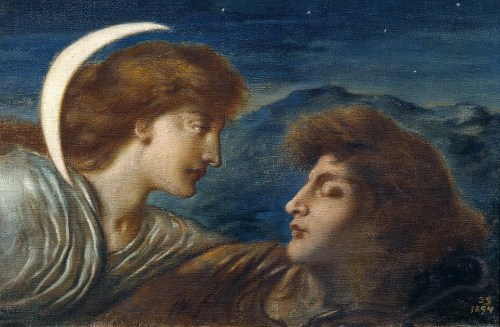
Mother Night

Mother Night
by Theodora Goss

Last night I went to the house of my mother, Night.
Her house has many doors, some large, some smaller
than a mouse hole. You are welcome at all of them.
Her house has many windows. They shine like stars
in the darkness, and on top of the highest tower
is the moon, like a weathervane.

I knocked and was invited into her parlor.
She asked me what was wrong, although of course,
as usual, she knew without my having to tell her.
“You’re tired,” she said. “So very tired, my dear.”
I simply nodded in answer.
It was true, I had been tired and sick with longing
for things I could not have: a cloak of darkness,
a library of answers, an elixir
that takes away all pain, a talking raven
to be my boon companion.

“You know the rules,” she said, pointing at the wall
where these words were written in calligraphy:
You can have anything you already have,
You can be anything you already are.
“How can I have what I don’t have?” I asked her.
“How can I be what I am not yet?” She simply
smiled and shook her head.

“Might as well say you cannot dream until
you are asleep, or cannot dance until
the music has started playing, when you know,
it is the dream that draws your eyelids down,
the dance that summons the tune. Are you a child,
to think clocks only run forward?”

I felt like an idiot, as when I was her student
and bungled every lesson with common sense
when it was uncommon sense her teaching called for.
I sat on the parlor sofa, crying in frustration
while she stroked my hair and poured me a cup of tea,
served with her usual mixture
of metaphysics and sympathy.
Why had I come, after all? I was not certain.

“Now think, my dear,” she said, “or rather, don’t.
I seem to remember thinking never got you
anywhere but Confusion.” She was right, of course:
in school that was my regular destination.
I leaned back against a cushion and sipped my tea,
pondering the nature of reality, which resembles
a ball of string tangled by a kitten.

“I’ll weave myself a cloak of darkness,” I said,
finally. “For the thread,
I’ll unravel my own shadow. The library,
I already have; I just need to catalog
the volumes I own correctly.” “And the elixir?”
she asked. Her eyes were shining, as they do
when a student of hers is being unusually clever.
“Doesn’t exist,” I said, “because pain itself
is the elixir of life. Without it, we may
as well be dead.” I didn’t like that answer.
But after all, we never get everything
we want, not even at Christmas.
“As for the raven, I believe one will come
to me when I’m wise enough for it to talk to.
You know they’re most particular.”

“You’re wiser than you were already,” she answered,
patting my head, which was a bit patronizing,
but I didn’t mind it, from her.
“You’re wrong about the elixir. I’ll tell you the secret
of dealing with pain, which is poetry.
It never gets into every nook and cranny;
nevertheless, I think you should write it more often.
As for the raven, I may have one around here
that I can lend until you find your own.”

She sent me home with some gingerbread and a bird,
rusty black, eyeing me with suspicion.
Now, it sits in the library, perched on a stack
of books I’m trying to get in the right order
so I can find an answer — to anything, really.
She was right about the poetry.
And I’m weaving my cloak of darkness. Mother Night
isn’t the easiest teacher, but her advice
is generally to be relied on.
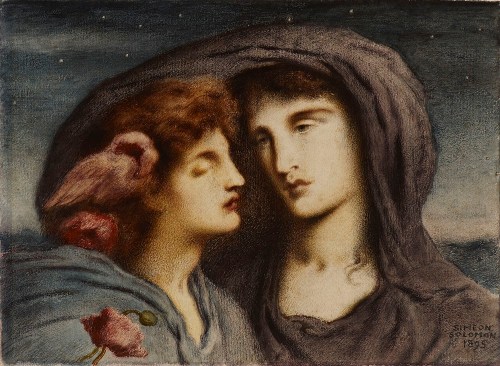
(The image is Night Looking Upon Sleep Her Beloved Child by Simeon Solomon.)
Posted in Uncategorized | Leave a comment

The Phantom Lover

The Phantom Lover
by Theodora Goss

The one I have loved is a shadow
or the ghost of a dream,
a phantom made of starlight
cast on a stream,
whose voice is the murmur of beeches,
whose touch the wing
of a moth that rises with darkness,
or a spider’s sting.

He walks with the sound of branches
that creak in the dark.
I wake and find on my shoulder
a burning mark,
as though hot wax has fallen
on my white skin.
I am conscious of confusion
and pleasing sin.

No boot has come over the casement
though the window’s wide,
and only the call of an owl
is sounding outside,
but my love has been, like a shadow
or the ghost of a dream,
a phantom made of starlight
cast on a stream.

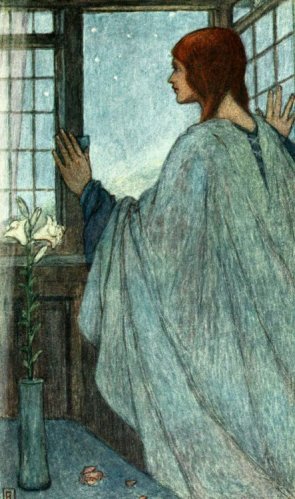
(The image is an illustration by Emma Florence Harrison.)

Posted in Uncategorized | 2 Comments

The Fox Wife

The Fox Wife
by Theodora Goss

I saw you dancing in a glade alone,
feet bare and dressed in nothing but a rag,
your red hair like a fire around your head.
I had to stand and look and keep on looking.

I saw you standing there among the trees,
smelled you before I saw you. First, I thought
you were a hunter. But no, you smelled of earth,
not death. I danced because I saw you looking.

Day after day, I went back to that glade.
And sometimes you were there, and sometimes not.

That was deliberate. I did not want you
to always get what you were coming for.
One day you stepped into the glade and spoke:
“I have been watching you. Can you forgive me?”

I wanted to say more: you burn so brightly,
I wonder that the forest is still standing.
You are more graceful than a flock of doves.
You should be dressed in silk instead of rags.
I am only a farmer, but I love you.

And yet somehow you said all of those things.
At least, I heard them and I followed you
out of the forest and into the farmyard.
The dogs barked, but you would not let them near me.

I did not know why all the dogs were barking.
What was it made you come? Now tell me truly.
Was it the possibility of finding
a home, a husband, not some soggy burrow?

That, I suppose. And then you looked so handsome.
And then there were the dresses, silk as promised.
I could have done worse than a prosperous farmer.

Or better: you would make a splendid lady,
upon your horse and riding by his lordship.

You flatter me. But then, you know I like it.
When I was heavy with our oldest son,
you told me I still looked just like the girl
you first saw dancing in the forest glade.

And so you did. Now dear, be reasonable . . .
Were we not always happiest together,
on rainy afternoons when you sat sewing
and I would read to you from some old book?
Or when we would go walking in the spring
to see the glade you dance in filled with bluebells?
Or when we watched our sons and daughter sleeping,
three heads with hair like fire upon the pillows.
Where are they now? Where are our children, dear?

Down in the burrow, safe from you and yours.

I would not hurt a hair upon their heads.

You hung my sister’s pelt upon the door.
You said there had been foxes in the henhouse.
You set those traps and did not think to tell me.

But how was I to know? Be reasonable . . .

Each night, while you lay sleeping, I snuck out.
A thing that was once wild is never tame.
I went to smell the earth, to meet my kind.
I went to see the bright disk of the moon.
You set those traps and caught my sister in one.
And what should I see on the henhouse door
next morning when I went to gather eggs?
Our children are asleep inside this burrow.
Your dogs would tear them up within an instant.

But dear, they’re human too, you can’t deny that.

Your dogs would. They shall learn the forest paths,
learn how to hunt, how to avoid the hunter.
They shall be cold in winter, wet in storms,
they shall eat mice and rabbits, roam the meadow,
drink from the streams and try to catch the birds.
When they are grown, they’ll put on human skins
and go into the town, but I shall warn them
never to fall in love. Not with a human.

Why can’t you see that I meant you no harm?
I did not know . . . My dear, won’t you forgive me?

I am not tame. I can’t be reasoned with,
and there is no forgiveness in the forest.
Either kill me with that gun you carry,
or go.

          He went. The birches heard him weeping.

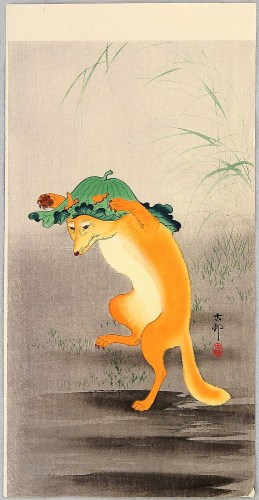
(The image is Dancing Fox by Ohara Koson.)

Posted in Uncategorized | Leave a comment

The Sound of Rain

The Sound of Rain
by Theodora Goss

Is there anything as beautiful
as the sound of rain
when you are tucked safe and warm and fed
into a comfortable bed
with roses on the counterpane,
while through the window
comes the cold gray light of autumn
like a promise of purpose after rest —
a world of red leaves and crisp winds,
of puddles and scuttling clouds,
once you have left
this down and flannel nest?

But in the meantime,
raindrops are pattering on the porch
like metronomes
all set to a different tempo,
and you can slip away
for a little while longer, head
lying on your pillow,
into the freshly-laundered country
of dreams.

(The image is Woman Reading in Bed by Gabriel Ferrier.)

Posted in Uncategorized | 1 Comment

A Taxonomy of Storms

A Taxonomy of Storms
by Theodora Goss

You tell me there are seven kinds of storms.

Rainstorms that come in autumn, soaking the leaves
which have fallen, red and gold, on the city sidewalks,
running down the gutters and into the grates,
forming pools in potholes that we can stand in
with our rain boots on, pretending to be children
once more, and mirroring back another world
we could get to if only we could jump through puddles
to the other side. Then there are hailstorms that send
pellets of ice to beat on our umbrellas
like inexperienced drummers. Snowstorms seem
so much gentler in comparison,
as though winter had shaken out her counterpane,
sending stray feathers over the shrubbery,
over the lawns. At first we make angels and snowmen,
at first we have snowball fights and dream of Christmas,
but after three weeks, trudging between packed banks,
we curse the stuff, no longer immaculate,
but splashed by cars, the brown of axle grease.
Then there are ice storms, which bring down power lines.
One morning we wake to a world encased in ice,
glittering like a diamond, and as hard,
brilliant, deadly, reminding us that nature
is a careless mother who kills more than she heals.

Thunderstorms, you tell me, are rainstorms with thunder
and lightning — which of course I could have guessed.
I know the pleasure of listening for that rumble
in the distance, of waiting for the lightening flash
from behind the safety of a window, warm beneath
a blanket, with a book open on my lap.
You tell me about tornadoes and hurricanes,
which are different, you say, although both involve high winds,
rotating winds, like being on a carousel
that you can’t get off, whose horses are mist and cloud.
Those sound the same, I say, simply to provoke you,
because I like to see your forehead wrinkle
when you frown, explaining that there are differences,
important differences, such as for example
that tornadoes occur on land, while hurricanes
are almost always at sea, where they topple ships.
Instead of blowing houses from Kansas to Oz,
I say. You look at me doubtfully, and I try
not to laugh, because you don’t like to be laughed at,
not about things like storms, or tax returns,
or car inspections, or the proper occasion
on which to wear your father’s antique cufflinks.

What if I told you that you are my favorite storm,
not a rainstorm, or ice storm, or hailstorm, but some other kind,
an eighth kind of storm the meteorologists
haven’t classified yet? As beautiful and dangerous
as any hurricane: you have blown my ships,
with their fresh white sails, like the wings of seagulls, far
out to sea, where I don’t know how to find them,
and all I can do is watch lightning play on the water,
which rises in foaming crests and then crashes down
on the gray rocks of the shore with a sound like thunder
that I recognize as the beating of my own heart . . .

(The image is Blown Away by Winslow Homer.)

Posted in Uncategorized | Leave a comment

Tell Me Your Name

Tell Me Your Name
by Theodora Goss

Tell me your first name. Tell me
your last name, the one your father gave you,
your patronymic. Tell me your middle name,
the one you don’t like, which was also
your grandfather’s name, which he did not like either,
going always by his initials. Tell me your mother’s
maiden name, which you use as a pseudonym
on the covers of your novels.

Tell me the nickname you went by in high school,
and then the one you went by in middle school,
and elementary school. Tell me what your parents called you
when you were too small, they thought, for the mouthful
written on your birth certificate.

Tell me the name your first girlfriend gave you,
as well as the one you gave yourself in your blanket fort,
your secret name. Tell me, additionally, your superhero name,
your Indian chief name, your policeman name,
the name you had when you were a pirate,
when you were an airplane. What was your name
on your fake i.d., on the debate team, in law school?

What did your first wife call you when she was pleased,
and when she was angry? When you were in bed together?
What was your name when you became a father?
What do people call you when they think you are someone else?
What is your name in dreams? What do you call yourself
when you wish you were someone else, an airline pilot,
a CIA agent, an artist whose models are in love with him?
What does your mother call you, even now?

What does your dog call you when he wants to go out?
What name do the mountains use when they summon you?
What name does the rain know you by? Who are you to the birds,
and to the trees? What name do the sidewalks use
to gossip about you on your way to work in the morning?
When night comes and sings you lullabies,
whom does she sing to?

What was your name before you were born,
the name you had before there were names,
before the stars were made? Whisper
it in my ear, beloved, and I’ll tell you mine.

(The image is The Moon and Sleep by Simeon Solomon.)

Posted in Uncategorized | Leave a comment

The Thieves

The Thieves
by Theodora Goss

If you will steal for me the stars, my love,
I’ll stitch them randomly on my coat of night,
where they will glitter like a hundred eyes.

And I will steal for you the grinning moon
to put in your pocket, for luck when you want it.
How astonished she will be, to be taken
in such a fashion, from behind her veil of clouds!

Let us be like jackdaws, outcast, impenitent,
collecting our treasures, loyal only to each other.
They will call us thieves, but why should that concern us?

If you will steal for me the autumn leaves
to make a gown in which I can dance with the treetops,
I’ll steal for you the mist that winds around mountain peaks,
like a cat around an ankle, so you can walk invisibly,
as mysterious to others as you have always found yourself.

My love, I will steal for you the sound of water
and the motion birds make as they move through the air,
everything precious and rare. And you, will you steal for me
the solemn music of rocks? I would like to hear it.

Let us steal a house of gray stone, which we can decorate
with our loot: ancient tapestries made of the ferns
from a forest floor, curtains like the ocean,
furniture from the best museums in Paris and Amsterdam,
a mahogany bed shaped like a swan.

Let us be partners in crime, never caught
unless it is together, never betraying each other,
escaping out of every prison they make for us, uncontainable.
If we die, let it be in a blaze of gunfire like constellations
exploding. We shall be legendary.

Already, my love, I have stolen for you
the words to make this poem, which some other poet
would have put to better use,
without criminal intent.

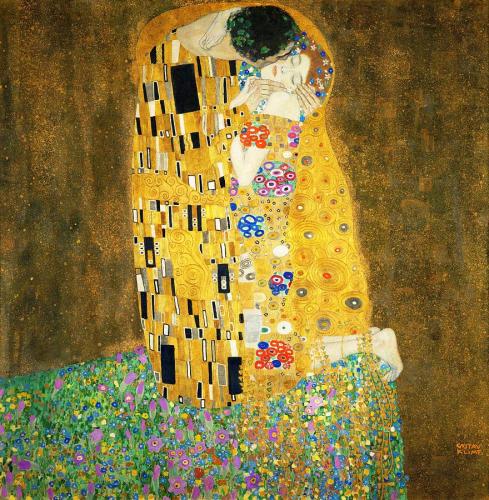
(The image is The Kiss by Gustav Klimt.)

Posted in Uncategorized | Leave a comment