
In Praise of Complexity
by Theodora Goss
The eye delights
in these: the corbels under the edge
of the roof of the Nemzeti Múzeum,
which look like furled
bits of foliage, perhaps acanthus leaves
curled in on themselves, and then between
them, purely decorative, the white stone
fleurons, like five-petaled roses, so that beneath
the roof flourishes an orderly garden
which, unexpectedly, includes lions —
their mouths open in a silent roar.
All this just to hold up
the roof, on which pigeons build their nests.
They are equally inhabitants
of the museum park, perching in the chestnut trees,
drinking from the white stone fountain,
rising in aerial ballets,
gray, white, black, brown, some of them
with a ring of green iridescence
around their necks. They are more graceful
than we could ever be. The eye delights, too,
in this complexity: the design
of the pigeons, variegated and variable;
the design of their flight up from the gravel
paths, past running children, to the roof;
the design of the chestnut leaves against the stone
walls of the museum; the ancient windows
with their wavering glass
panes reflecting, irregularly, the branches
moving in the wind, the passing wings.
And then the life everywhere:
the chestnut trees whispering, the clatter
and flutter of the pigeons, parents shouting
after children engaged in the terrestrial ballet
of running after balls. The eye
of the observer sees it all, hears
it all, and also, somehow,
I’m not sure how,
from the stone garden under the roof,
the silent lions roaring.
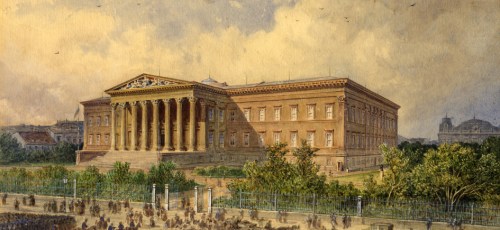
(The image is an old painting of the Magyar Nemzeti Múzeum.)

 Theodora Goss: Poems